



Contract farming is a widely used organizational arrangement that connects smallholders with modern agri-food markets, particularly in emerging economies where fragmented production systems, market uncertainty, and limited resources constrain rural producers (Singh et al., 2025; Ncube, 2020). Through pre-arranged agreements between firms and farmers, contract farming reduces market risk, improves access to inputs and technical support, and ensures supply reliability and quality compliance. For agribusiness firms, it offers production control without full vertical integration, while farmers benefit from assured markets and reduced exposure to price volatility (Swain and Teufel, 2025; Senesi et al., 2017).
The poultry sector is a vital component of Bangladesh’s livestock industry, significantly contributing to the country’s economy, employment, and food security. It provides affordable animal protein and creates substantial employment opportunities in both rural and urban areas (Devnath et al., 2025; Masud et al., 2020). The livestock sub-sector contributes around 12% to agricultural GDP and supports nearly 20% of rural employment (Sobur et al., 2024). Additionally, poultry farming plays an important role in poverty reduction and income diversification among smallholders. In terms of nutrition, the sector supplies about 68% of total meat and 64% of egg demand, with poultry meat accounting for nearly 37% of overall meat production in Bangladesh (Devnath et al., 2025; Rashid et al., 2023).
The poultry industry provides an important context for studying contract governance because broiler production requires strong coordination, quality control, and timely decision-making (Nassar and Abbas, 2025). In many Asian countries, contract-based poultry systems have supported rapid commercialization by integrating feed supply, hatcheries, veterinary services, processing, and distribution (Singh et al., 2025). Bangladesh has experienced similar growth due to urbanization, rising incomes, changing diets, and increasing demand for affordable animal protein (Kleyn and Ciacciariello, 2021). Consequently, poultry farming has become a major contributor to employment, nutrition, and rural economic development. Contract broiler farming, particularly in northern Bangladesh, has emerged as a key supply-chain model through collaborations between integrators and growers under input-output contracting systems (Chatterjee et al., 2022; Nkukwana, 2018).
In broiler contract farming, firms typically supply chicks, feed, medicine, technical support, and buyback guarantees, while farmers provide housing, labor, and flock management (Wongtangtintharn et al., 2025; Fadilah et al., 2025). Although this system lowers entry barriers and stabilizes procurement, sustaining long-term farmer participation remains challenging due to delayed payments, weak communication, inconsistent services, and perceived power imbalances (Singh et al., 2025; Ruml and Qaim, 2021).
Previous research has primarily focused on participation, productivity, and welfare outcomes, while giving limited attention to farmer retention and relationship sustainability. In poultry farming, long-term continuity relies heavily on repeated interactions that foster trust, fairness, and responsiveness. From a management perspective, retaining experienced growers is akin to customer retention in business relationships, as stable grower networks lower transaction costs and enhance operational efficiency.
Farmer satisfaction hinges not only on profitability but also on the quality of communication, transparency, procedural fairness, technical support, and trust. Reliable and transparent interactions with company representatives bolster confidence and intentions for continuity, whereas poor relationship management leads to increased dissatisfaction. These findings underscore the importance of relational governance alongside economic incentives in sustaining contract farming systems.
Relational governance involves using trust, communication, shared norms, and cooperative behavior to manage exchange relationships beyond formal contracts (Chan et al., 2025). In agricultural systems marked by uncertainty and production risks, relational mechanisms mitigate opportunism and support long-term collaboration. In Bangladesh’s poultry sector, where standardized contracting practices and institutional safeguards are limited, growers often rely heavily on integrators for technical and financial support (Rahman et al., 2025; Hennessey et al., 2021). Consequently, the quality of relationships between farmers and firms significantly influences satisfaction and continuity decisions.
This study examines how technical support, communication quality, payment timeliness, settlement transparency, and input reliability affect farmer satisfaction and contract continuity intentions in broiler farming systems in northern Bangladesh. It further investigates whether relational factors are more influential than purely economic considerations in sustaining participation.
The study contributes to the literature on contract farming and supply chain governance by shifting the focus from participation and productivity to farmer retention and relationship sustainability. It also provides empirical evidence from Bangladesh and emphasizes the managerial importance of relationship-centered contracting. The findings suggest that growers should be regarded as strategic partners, as strong relational governance can enhance trust, reduce attrition, and improve the stability and resilience of poultry supply chains.
2. Materials and Methods
2.1 Ethical approval statement
No institutional ethical approval was required to conduct the study. Participation was voluntary, and respondents were informed about the study’s objectives, confidentiality measures, and their right to withdraw at any time. No personal identifiers were retained in the dataset, and all information was used strictly for academic purposes.
2.2 Research design
This study utilized a sequential explanatory mixed-methods design, combining survey data with qualitative interviews to examine the factors influencing farmer satisfaction and contract continuity in broiler farming. The quantitative phase analyzed the relationships among service quality, fairness, and retention intentions, while the qualitative phase provided context by interpreting the results through stakeholder experiences. This approach was selected because decisions regarding continuity are influenced by both economic and relational factors, such as trust, communication, and fairness. By integrating both methods, the study enhanced the depth and validity of the findings through triangulation.
2.3 Study context and research setting
The study was conducted in northern Bangladesh, specifically in the Bogura, Rajshahi, Rangpur, and Naogaon districts, which are characterized by a high concentration of broiler farms and active poultry integrators (Figure 1). These areas form a key broiler production cluster where input-output contracts are commonly practiced, encompassing chicks, feed, veterinary support, technical services, and buyback guarantees. This context is ideal for analyzing the dynamics of farmer–firm relationships within contract farming systems.
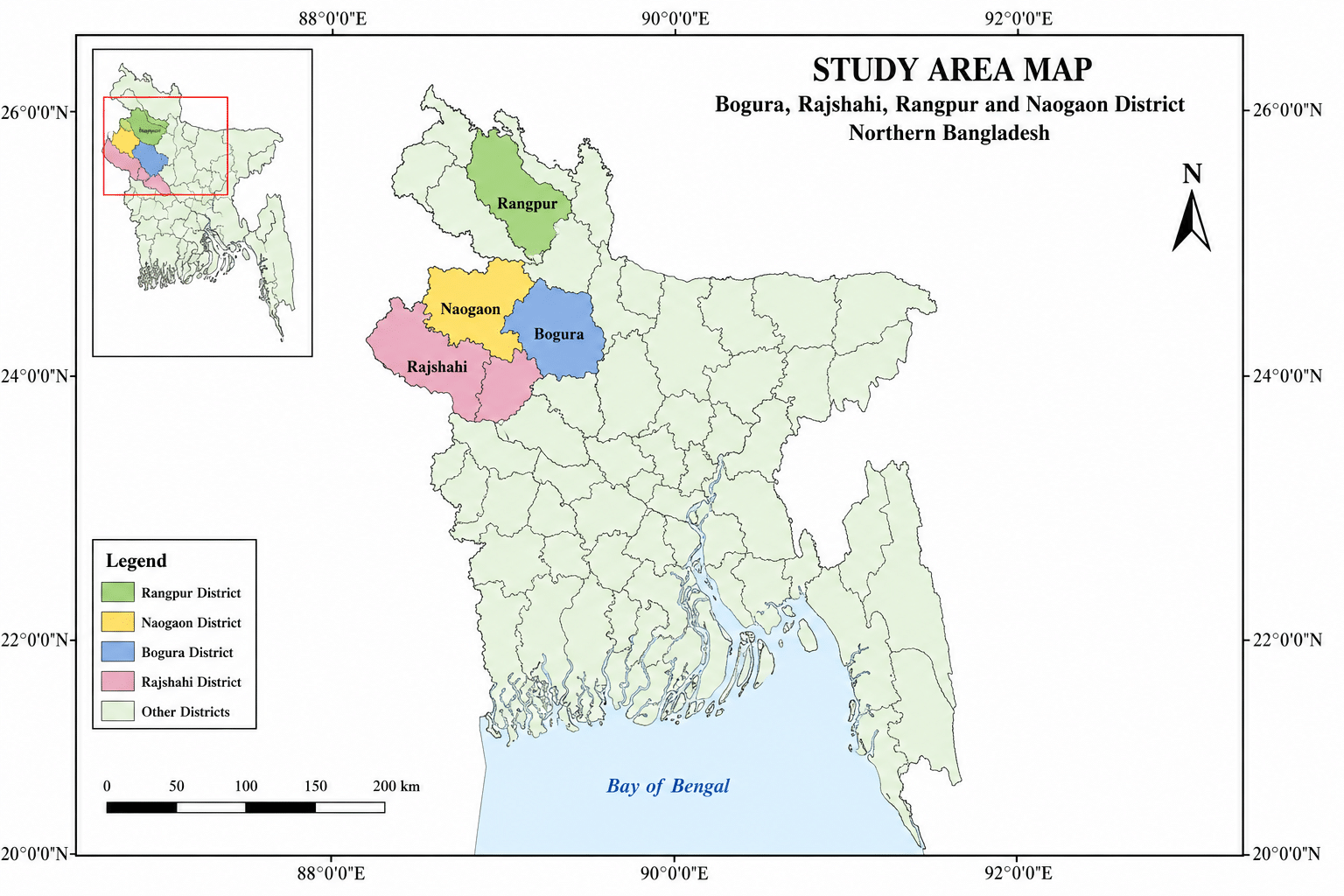
Figure 1. Map of the study area.
2.4 Population and sampling procedure
The target population consisted of active contract broiler farmers working with poultry integrator firms, with farmers serving as the primary unit of analysis due to the focus on satisfaction and continuity intentions. A multistage sampling approach was employed: first, four poultry-intensive districts were purposively selected; second, key broiler-producing upazilas were identified in consultation with local livestock officers and industry stakeholders; and third, farmer lists were obtained from company and local sources to select respondents using systematic random sampling where feasible. A total of 200 farmers participated in the survey, and 12 qualitative interviews were conducted with field officers and managers involved in farm coordination and contract management. The sample size was considered sufficient for regression analysis and aligned with standards in agribusiness research.
2.5 Data collection procedure
Primary data were collected from January to June 2025 through face-to-face interviews conducted by trained enumerators, as many respondents had limited formal education, making self-administered surveys unsuitable. The questionnaire was initially prepared in English, then translated into Bangla, and back-translated to ensure accuracy and consistency. A pilot test involving 15 farmers outside the study area was conducted, leading to necessary refinements that improved clarity and structure. Following the survey, semi-structured interviews with company officials were conducted to further interpret and support the quantitative findings.
2.6 Measurement of variables
2.6.1 Dependent variable
The dependent variable was contract continuity intention, defined as a farmer’s willingness to remain with the current integrator in future production cycles. It was measured using a three-point scale: 1 indicated no intention to continue, 2 represented uncertainty, and 3 indicated an intention to continue the contract.
2.6.2 Independent variables
Based on previous literature in relationship marketing, contract governance, and customer satisfaction, several key predictors were included in the analysis. These predictors comprised technical support quality (responsiveness, advisory usefulness, and problem-solving assistance), communication quality (accessibility, clarity, and frequency of contact), payment timeliness (speed and reliability of settlements), and settlement transparency (clarity of deductions and cost reporting). Additionally, input-related factors such as feed quality and chick quality were considered, along with perceived profitability, which reflects farmers’ satisfaction with the financial returns from the contract system.
2.6.3 Control variables
To control for potential confounding effects, the model included key socio-economic and farm characteristics such as farmer age, education level, farming experience, farm size, and contract duration. These variables were included to isolate the impact of the main explanatory factors on intentions for contract continuity.
2.7 Survey instrument and scale development
Perceptual variables were measured using a five-point Likert scale, ranging from 1 (very dissatisfied) to 5 (very satisfied). The measurement items were adapted from established studies on supplier relationship quality, service satisfaction, contract farming governance, and customer retention behavior, and were customized to fit the context of broiler contract farming in Bangladesh.
2.8 Reliability and validity assessment
Internal consistency was assessed using Cronbach’s alpha, with values above 0.70 deemed acceptable. The overall satisfaction scale demonstrated strong reliability, achieving an alpha of 0.87. Construct validity was evaluated through Exploratory Factor Analysis, employing principal component extraction and varimax rotation. The Kaiser–Meyer–Olkin value exceeded 0.70, and Bartlett’s test of sphericity was significant, confirming the data’s suitability for factor analysis. Content validity was established through a comprehensive literature review, expert feedback, and pilot testing.
2.9 Quantitative data analysis
Survey data were coded and analyzed using SPSS Version 26. The analysis followed four steps: first, descriptive statistics (means, frequencies, percentages, and standard deviations) summarized respondent profiles and satisfaction levels; second, Pearson correlation analysis examined the relationships between satisfaction dimensions and continuity intention; third, multiple linear regression assessed the relative influence of each predictor on continuity intention. The general model was specified accordingly.
Where:
- TS = Technical support
- COM = Communication
- PAY = Payment timeliness
- TRA = Transparency
- PROF = Profitability
Diagnostic testing: Variance Inflation Factors (VIF) were examined to test multicollinearity. Residual plots and normality checks were conducted to verify model assumptions.
2.10 Qualitative data analysis
Interview data were analyzed using thematic analysis, which began with a careful reading of the transcripts, followed by open coding of recurring ideas. The codes were then organized into broader themes and compared with quantitative results to ensure consistency. The main themes identified included trust in integrators, perceptions of fairness, dependence on field officers, issues with delayed settlements, and barriers to switching contracts. Integrating qualitative and quantitative findings enhanced the overall interpretation and strengthened the robustness of the results.
2.11 Methodological imitations
Several limitations should be acknowledged. First, the cross-sectional design captures farmers’ stated intentions rather than their actual future behavior. Second, the study relies on self-reported satisfaction measures, which may be influenced by perception bias. Third, although the selected region is a major poultry production hub, the findings may not be fully generalizable to all poultry-producing areas of Bangladesh. Despite these limitations, the mixed-methods approach, multi-district sampling, and triangulation of quantitative and qualitative data provide a robust and reliable foundation for analyzing farmer retention in broiler contract farming systems.
3. Results
3.1 Respondent profile and farm characteristics
The majority of respondents were aged between 31 and 50 years (71%), indicating that contract poultry farming is primarily managed by economically active middle-aged households. In terms of education, 72% had completed at least secondary education, suggesting a moderate level of literacy that is relevant for managing commercial production systems and understanding contractual arrangements. Nearly half of the respondents (48%) had between two and five years of experience in contract farming, while 43% had more than five years of experience. From an operational perspective, 72% of respondents were associated with medium-sized regional or large national integrators. Regarding the frequency of technical services, 89% reported receiving at least one regular farm visit per week, indicating relatively structured field support systems (Table 1).
Table 1. Socio-demographic characteristics of contract broiler farmers.
| Variable | Category | Frequency | Percentage |
| Age | 20–30 | 32 | 16.0 |
| 31–40 | 88 | 44.0 | |
| 41–50 | 54 | 27.0 | |
| >50 | 26 | 13.0 | |
| Education | No formal education | 14 | 7.0 |
| Primary | 42 | 21.0 | |
| Secondary | 86 | 43.0 | |
| Higher secondary+ | 58 | 29.0 | |
| Experience | <2 years | 18 | 9.0 |
| 2–5 years | 96 | 48.0 | |
| 6–10 years | 58 | 29.0 | |
| >10 years | 28 | 14.0 |
3.2 Contractual engagement patterns
Almost half of the respondents (46%) had contracts that lasted two to three years, while 26% had contracts that extended beyond three years. This suggests that long-term participation is common, though not universal (Table 2).
Table 2. Contract characteristics and service support profile of broiler farmers.
| Variable | Category | Frequency | Percentage |
| Contract duration | 1 year | 56 | 28.0 |
| 2–3 years | 92 | 46.0 | |
| >3 years | 52 | 26.0 | |
| Integrator type | Local | 58 | 29.0 |
| Regional | 86 | 43.0 | |
| National | 56 | 28.0 | |
| Technical visits | Once weekly | 42 | 21.0 |
| Twice weekly | 88 | 44.0 | |
| >Twice weekly | 48 | 24.0 | |
| Irregular | 22 | 11.0 |
3.3 Descriptive analysis of satisfaction dimensions
Farmers assessed key aspects of the contract relationship using a five-point Likert scale. Table 3 presents the mean scores and standard deviations. The dimensions that received the highest ratings were communication quality and technical support, indicating a positive perception of interpersonal service delivery. In contrast, payment timeliness and settlement transparency received the lowest ratings. This pattern suggests that while operational support systems are relatively effective, financial governance continues to be a significant source of dissatisfaction.
Table 3. Descriptive statistics of farmer satisfaction and contract service dimensions.
| Dimension | Mean | Standard deviation |
| Communication with officers | 3.72 | 0.68 |
| Technical support | 3.64 | 0.71 |
| Chick quality | 3.41 | 0.78 |
| Medicine availability | 3.33 | 0.80 |
| Feed quality | 3.26 | 0.89 |
| Profit margin satisfaction | 3.04 | 0.87 |
| Payment timeliness | 2.98 | 0.93 |
| Clarity of cost deductions | 2.81 | 1.02 |
3.4 Contract continuity intention
Respondents were asked if they planned to continue with their current integrator in the next production period. We found that 71% intended to continue, 18% were undecided, and 11% expressed intentions to discontinue (Figure 2). This distribution suggests generally favorable retention outcomes but also highlights a significant subgroup at risk of switching or disengagement. For firms operating under narrow margins and biologically time-sensitive cycles, even moderate attrition can lead to substantial coordination costs.

Figure 2. Contract continuity intention among respondents for the next production period with their current integrator.
3.5 Correlation analysis
The correlation results indicate that all dimensions of satisfaction are positively and significantly related to the intention to continue contracts, with a significance level of 1%. Technical support (r = 0.529) and communication quality (r = 0.507) exhibit the strongest associations, highlighting the importance of relational and advisory services. Payment timeliness, cost transparency, chick quality, and feed quality also demonstrate positive but moderate relationships, suggesting that both relational and operational factors influence farmers’ willingness to continue contracts, with relational aspects being more significant (Table 4).
Table 4. Correlation between satisfaction dimensions and continuity intention.
| Variable | r-value |
| Technical support | 0.529*** |
| Communication quality | 0.507*** |
| Payment timeliness | 0.462*** |
| Cost transparency | 0.445*** |
| Chick quality | 0.412*** |
| Feed quality | 0.386*** |
***P < 0.01
3.5.1 Hypothesis testing (bivariate stage)
All proposed hypotheses were supported by the analysis, indicating that technical support, communication quality, payment timeliness, settlement transparency, and input quality each have a positive and significant influence on farmers’ intention to continue with contracts. These results suggest that improvements in both relational service factors and operational contract conditions enhance farmers’ willingness to stay in contract farming arrangements. The findings underscore the importance of integrated service quality and governance mechanisms in shaping retention behavior in broiler contract systems (Table 5).
Table 5. Summary of hypothesis testing results on determinants of contract continuity intention.
| H | Statement | Result |
| H1 | Technical support positively affects continuity intention | Supported |
| H2 | Communication quality positively affects continuity intention | Supported |
| H3 | Payment timeliness positively affects continuity intention | Supported |
| H4 | Settlement transparency positively affects continuity intention | Supported |
| H5 | Input quality positively affects continuity intention | Supported |
H=Hypothesis
3.6 Multivariate regression analysis
The multiple regression analysis indicates that all included predictors positively and significantly impact farmers’ intention to continue contracts. Technical support emerges as the strongest determinant (β = 0.318, p = 0.001), followed by communication quality (β = 0.271, p = 0.004) and payment timeliness (β = 0.236, p = 0.010) (Table 6). Cost transparency, chick quality, and feed quality also demonstrate significant positive effects, though with comparatively smaller coefficients. Overall, the results suggest that both relational service factors and input-related quality significantly contribute to farmers’ willingness to continue contracts, with technical and communication support playing the most influential roles.
Table 6. Multiple regression results showing the effects of satisfaction dimensions on contract continuity intention.
| Predictor | Beta | t-value | P -value |
| Technical support | 0.318 | 3.89 | 0.001 |
| Communication quality | 0.271 | 2.96 | 0.004 |
| Payment timeliness | 0.236 | 2.61 | 0.010 |
| Cost transparency | 0.212 | 2.39 | 0.018 |
| Chick quality | 0.189 | 2.21 | 0.022 |
| Feed quality | 0.152 | 2.03 | 0.036 |
3.7 Qualitative findings
The interview findings provided deeper insight into the quantitative results, revealing three key themes. Farmers emphasized that transparency in settlements was more important than short-term profits; unexplained deductions reduced confidence in integrators, highlighting the role of procedural justice in continuity decisions. Field officers were widely viewed as the “face of the company,” and effective technical support and communication during disease outbreaks and management uncertainty strengthened trust and loyalty. Additionally, many farmers were reluctant to switch firms despite moderate dissatisfaction due to uncertainty about alternative integrators, suggesting the presence of switching barriers and risk-averse continuity behavior. Therefore, continuity should not always be interpreted as genuine loyalty; it may also reflect constrained choices. To provide a clearer comparative perspective, the satisfaction dimensions were further ranked based on their mean scores (Table 7). The results indicate that communication quality (mean = 3.72) and technical support (mean = 3.64) are the highest-rated aspects of the contract farming relationship. This suggests that farmers place considerable value on regular interaction and the advisory services provided by company field officers. In contrast, payment timeliness (mean = 2.98) and cost transparency (mean = 2.81) were ranked lowest among all dimensions, indicating persistent dissatisfaction with financial governance mechanisms. Profit margin satisfaction also remained relatively modest (mean = 3.04), reflecting concerns over economic returns despite generally positive perceptions of service delivery.
Table 7. Ranking of satisfaction dimensions.
| Rank | Dimension | Mean score | Interpretation |
| 1 | Communication | 3.72 | High satisfaction |
| 2 | Technical support | 3.64 | High satisfaction |
| 3 | Chick quality | 3.41 | Moderate |
| 4 | Medicine availability | 3.33 | Moderate |
| 5 | Feed quality | 3.26 | Moderate |
| 6 | Profit margin | 3.04 | Moderate–low |
| 7 | Payment timeliness | 2.98 | Low |
| 8 | Cost transparency | 2.81 | Lowest |
4. Discussion
The findings indicate that farmer continuity in broiler contract farming is influenced not only by economic returns but also by relational governance factors such as trust, technical support, procedural fairness, and communication quality. This suggests that the long-term sustainability of contract farming depends largely on strong farmer-integrator relationships rather than formal contracts alone. Technical support was identified as the strongest predictor of continuity intention, as farmers were more likely to remain with integrators whose representatives were responsive, knowledgeable, and accessible. This finding aligns with previous studies showing that extension services and technical assistance significantly encourage farmer participation in contract farming systems (Rondhi et al., 2020). Similarly, research on broiler cost efficiency concluded that training, monitoring, and continuous feedback mechanisms are essential for improving grower performance under contract systems (Aji et al., 2023). In the Bangladesh context, technical officers function not merely as production advisors but also as relationship managers who alleviate operational anxiety during disease outbreaks, mortality shocks, or market uncertainty. This indicates that field-level human capital is a strategic asset for integrator firms.
Communication quality was the second strongest predictor of continuity intention, emphasizing the importance of relational exchange in contract farming. Farmers who received timely updates, clear explanations, and regular interactions with company representatives demonstrated stronger intentions to continue with their integrators. Consistent with relationship marketing theory, effective communication builds trust, reduces misunderstandings, and strengthens long-term commitment. In agricultural contracting, poor communication regarding pricing, feed supply, or payment delays can create dissatisfaction and suspicion. Thus, communication functions not only as an administrative activity but also as a governance mechanism that stabilizes expectations and maintains farmer confidence.
The importance of payment timeliness and settlement transparency also deserves particular attention. Although contract growers expressed moderate satisfaction with operational support, financial governance dimensions received the lowest descriptive scores. Regression results, however, confirmed that timely payment and clear deductions significantly influenced continuity intention. This pattern suggests that farmers may tolerate moderate shortcomings in other areas, but financial ambiguity directly undermines trust. Earlier studies from Lebanon and other poultry markets similarly report that delayed payments and weak contractor accountability are major sources of dissatisfaction among broiler growers (Kozhaya, 2020). Historical evidence from Bangladesh also documented that contract farming became attractive partly because it reduced price risk and improved market certainty, implying that failures in payment reliability weaken one of the core value propositions of the model (Singh et al., 2025).
From a governance perspective, these findings support transaction cost economics. In environments characterized by uncertainty, bounded rationality, and incomplete contracts, growers cannot anticipate every contingency in advance. Consequently, ex post behavior—such as whether firms honor commitments quickly and transparently—becomes central to the continuity of relationships. When settlements are delayed or deductions remain unclear, farmers may perceive opportunism, even if formal contract clauses exist. This indicates that written contracts alone are insufficient; procedural fairness must be evident in practice.
Another important contribution of the study is the relatively weaker role of feed and chick quality compared to relational variables. Both input-quality measures were significant predictors, yet their explanatory power was lower than that of technical support, communication, and payment reliability. This does not imply that biological inputs are unimportant. Rather, it suggests that farmers evaluate contract relationships holistically. When service systems are reliable and communication is strong, moderate dissatisfaction with inputs may be tolerated because growers believe problems will be addressed fairly. Conversely, even good-quality inputs may fail to secure loyalty when trust has deteriorated. This interpretation aligns with studies in vertically coordinated poultry systems, which show that the quality of contract design and support structures often matter as much as production economics (Harianto et al., 2019).
The findings also illuminate the concept of risk-adjusted loyalty. Qualitative responses indicated that some farmers remained with current integrators despite frustrations because switching to another firm was perceived as risky. Similar patterns have been reported in Asian poultry markets, where growers evaluate contract arrangements not only based on profitability but also on stability and predictability (Huang, 2018). This means that observed retention should not automatically be interpreted as genuine satisfaction. Some continuity may reflect switching barriers, fear of worse alternatives, lack of market information, or dependence on credit and technical support. For managers, this distinction is critical. Retention based on trust is durable, while retention based on constraint is fragile and vulnerable to competitor entry.
The Bangladesh context makes these findings particularly relevant. Poultry supply chains often involve small and medium growers with limited working capital, narrow liquidity buffers, and a high dependence on company inputs. Under such conditions, even short payment delays can disrupt the next production cycle (Islam et al., 2025; Hennessey et al., 2021). Similarly, disease events can quickly erase profitability, increasing reliance on company guidance. As a result, farmer perceptions of responsiveness and fairness become economically significant rather than merely psychological (Omuse et al., 2026). Integrators that underestimate these relational dynamics may incur hidden costs through attrition, inconsistent supply, reputational damage, and increased recruitment expenses (Fletcher and Trautrims, 2024).
From a managerial perspective, broiler integrators should transition grower management from a transactional function to a strategic, relationship-based approach. This involves improving field officer recruitment and training, digitizing settlement systems for transparent payments, establishing formal grievance mechanisms, and enhancing communication through digital platforms. Such measures align with supply chain research, which emphasizes trust and transparency as key drivers of resilience.
The study contributes to contract farming literature by highlighting farmer retention as a multidimensional outcome shaped by service quality, trust, and governance rather than price alone. It reframes contract farming as an ongoing inter-organizational relationship that requires continuous management. While some findings may reflect reverse causality or farmer experience effects, the combined quantitative and qualitative evidence supports the conclusion that relational governance strongly influences continuity. Overall, sustained farmer retention in broiler contract systems depends more on fairness, support, and respectful relationships than on financial incentives alone.
5. Conclusions
This study found that farmer satisfaction and contract continuity in Bangladesh’s broiler farming sector are influenced not only by profitability but also by relational factors such as technical support, communication quality, payment timeliness, and settlement transparency. Among these factors, technical support and communication emerged as the strongest predictors of continuity intention, underscoring the importance of trust-based relationships between farmers and integrators. Farmers were more likely to remain in contracts when they experienced fair treatment, responsive service, and transparent financial transactions. In contrast, delayed payments and unclear deductions undermined their confidence and increased intentions to switch. The findings suggest that long-term sustainability and competitiveness in broiler supply chains depend not only on economic incentives but also on effective relational governance through strong field support, transparent payment systems, and efficient communication.
