



Fish accounts for about 17% of global animal protein consumption (Benett et al., 2018). In addition to this benefit, fishery products serve as a primary source of animal protein and provide many direct and indirect jobs worldwide. Efforts must be combined to ensure the sustainability of both the resource and the activity. Furthermore, in countries and regions where fishing may not be the primary source of employment, fishery products can help alleviate poverty in low-income households (Melnychuk et al., 2020). The balance between fish production capacity and the fishing effort applied to it is crucial for sustainable fisheries management. When fishing effort becomes excessive, the pressure on fish stocks increases, leading to a reduction in their abundance. The status of fish stocks, as indicated by their abundance and fishing pressure relative to management targets, is primarily estimated using two broad categories of methods (Melnychuk et al., 2020). First, stock status can be scientifically assessed by applying mathematical models to data collected from the fishery. Second, the status of stocks is often determined by qualitative expert opinion, drawing on the knowledge of those familiar with the fishery regarding trends in catch, fishing effort, and potentially the size of the fish.
Small pelagic fish play a crucial role in marine ecosystems due to Their intermediate position in food webs and significant biomass (Jehid, 2016). Global production of small pelagic fish is approximately 39 million tons, accounting for more than one-third of the total catch, making these fish the most widely fished in the world (FAO, 2002). The situation in West Africa, particularly in Côte d’Ivoire, mirrors this global trend. In Côte d’Ivoire, small pelagic fish, notably Sardinella aurita and S. maderensis, serve as the primary coastal fishing resource (Weigel, 1999). The flat sardinella can be distinguished by a black spot located behind the operculum, while in S. aurita, the black spot is found on the operculum itself (Jehid, 2016). S. maderensis is characterized by a somewhat sedentary lifestyle and can be found in both superhaline and desalinated environments. This adaptability allows it to be fished by both marine fisheries and those in lagoons and estuaries, making it a relatively accessible and popular species. The International Union for Conservation of Nature (IUCN) lists this species on its red list of overexploited and threatened species (Tous, 2015). Due to its accessibility, S. maderensis has experienced significant exploitation over the past decade in Côte d’Ivoire, with landings of the species declining from 7,031 to 3,984 tons (DP, 2020).
Sustainable and effective fisheries management relies on fundamental tools, including stock assessments. However, in most cases, many fish stocks in commercial catches have not yet been assessed. This lack of assessment raises significant issues regarding the availability of crucial data, particularly biological reference points (Hilborn and Branch, 2013). Any exploitation of fish resources must be coupled with knowledge of the population dynamics of the stock. Additionally, population dynamics drive changes in the abundance or biomass of a stock over time, contributing to a better understanding of the stock and the processes that influence its current state and future evolution. Data on the population dynamics of a stock are vital for its management. Research on the status of the S. maderensis stock has been conducted in neighboring countries, including Liberia and Ghana (Ampossah et al., 2019; Wehya et al., 2017). However, in Côte d’Ivoire, data on the stock status of this species are very limited, which is necessary for the sustainable management of the resource. The present study aims to address this gap by providing data on the population dynamics of the species, particularly the stock's exploitation level, to assist managers in making informed decisions for sustainable resource management.
2. Materials and methods
2.1 Ethical approval statement
No ethical approval was required for this study.
2.2 Study area
Four landing stations were selected based on their accessibility and the intensity of fishing activities: Azuretti (Grand-Bassam) at 5°12'23.68"N, 3°47'57.89"W; Ossibissa (Abidjan) at 5°16'44.90"N, 4°03'14.58"W; Lahou Kpanda (Grand-Lahou) at 5°08'11.47"N, 5°01'33.77"W; and Fresco at 5°05'53.85"N, 5°34'46.38"W (Figure 1).
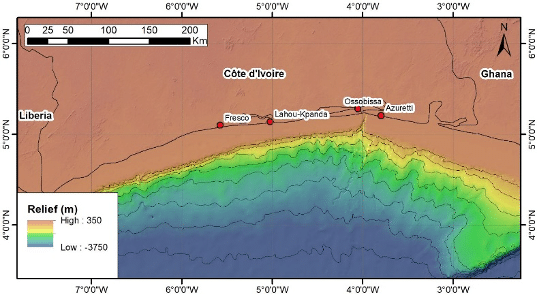
Figure 1. Map showing the sampling stations (0).
2.3 Data collection
Fish samples were collected monthly from landing sites using beach seines, purse seines, and gill nets during the sampling period from April 2022 to March 2023. Length frequency data were gathered for approximately 2,112 specimens of S. maderensis, and individuals were identified to the species level (Schneider, 1999). Each individual was measured for total length (TL) to the nearest millimeter using a measurement board, and their weight was recorded with an electronic scale.
2.4 Analytical methods
2.4.1 Growth parameters
The Von Bertalanffy Growth Function (VBGF) which best describes the fish growth as: Lt= L∞ (1-e -k(t-t0)) (Pauly, 1979). The theoretical age at zero length (t0) was determined following this equation: log10 (−t0) = − 0.3922 − 0.275 x log10L∞ − 1.038 x log10K (Pauly, 1979). The Longevity (Tmax) was estimated (Pauly, 1983). The estimated values of L∞ and K were used to calculate growth performance Phi-prime (Φ’) value (Pauly and Munro, 1984).
2.4.2 Mortality parameters
The length-converted catch curve method implemented in Fisat II software was used to estimate the instantaneous rate of total mortality. The instantaneous rate of natural mortality (M) was estimated using length-growth data from empirical equations, with a mean water temperature of 27.5 °C (Pauly, 1980). The instantaneous rate of fishing mortality (F) was estimated using the relationship F = Z - M, where Z and M are defined as above. To assess the state of the stock based on mortality rates, the exploitation ratio (E) was calculated using the formula E = F / (F + M). This provides a rough estimate of whether the stock is overfished (E > 0.5) or not (E < 0.5) (Pauly, 1983). The optimal value of E is approximately 0.5, assuming that sustainable yield is maximized when F is roughly equal to M (Gulland, 1971).
2.4.3 Length and age at first capture
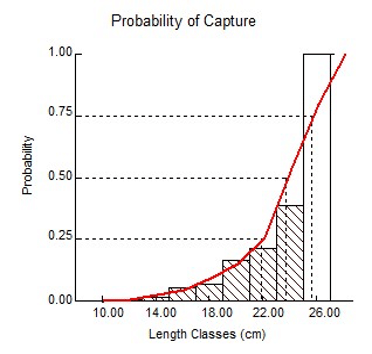
The lengths at first capture, Lc50, Lc25, and Lc75, for S. maderensis were derived from the length-converted catch curve. The probability of capture was determined using a graph of cumulative probability plotted against mid-length. Consequently, Lc50 corresponds to the cumulative probability at 50%, while Lc25 and Lc75 are linked to cumulative probabilities at 25% and 75%, respectively. The estimation of age at first capture (tc50) was conducted following the method of Beverton and Holt (1957).
2.4.4 Length and age at first sexual maturity
Both the length at first maturity (Lm50) and the age at first maturity (tm50) were determined (Hoggarth et al., 2006; Goonetileke and Sivasubramania 1987).
2.4.5 Recruitment pattern
Recruitment pulse was reconstructed using a time series of length-frequency distribution to identify the annual pulses and the relative strength of each pulse (Amin et al., 2009). The length at first recruitment (Lr) was defined as the midpoint of the smallest length class (Gheshlaghi et al., 2012), and the age at first recruitment (tr50) was determined (Beverton and Holt, 1957).
2.4.6 Relative yield per recruit (Y/R) and relative biomass per recruit (B/R)
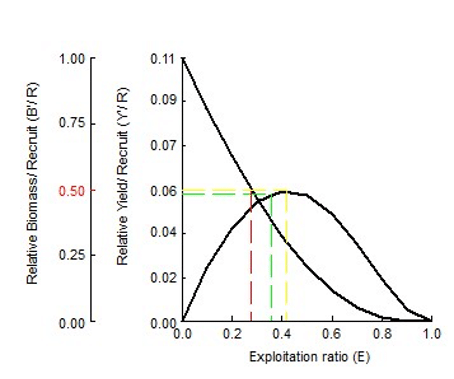
Relative yield per recruit (Y/R) and relative biomass per recruit (B/R) were calculated as functions of exploitation. Additionally, the exploitation rate at maximum (Emax), which corresponds to the exploitation value correlating with maximum yield production (E0.1), was determined for a marginal increase of Y'/R at 10% of its virgin stock. Furthermore, E0.5, the exploitation rate at which the stock is reduced to 50% of its unexploited biomass, was computed using the procedure that incorporates the knife-edge option fitted in the Fisat II tool.
2.5 Statistical analysis
The length frequency data were pooled into groups with 2 cm length intervals, and the estimation of population parameters was conducted using the FAO-ICLRAM Stock Assessment Tool (FISAT) (Gayanilo et al., 1996; Pauly, 1987).
3. Results
3.1 Length frequency distribution and growth parameters
The length frequency distribution of S. maderensis shows a minimum length of 12 cm, a maximum observed size of 41 cm, and an average length of 23.03 ± 19.09 cm during the study period (Figure 2). Figure 3 presents the restructured length frequency data superimposed with the estimated growth curve. Growth parameters, including asymptotic length (L∞), growth coefficient (K), theoretical age (t0), Tmax, and Phi-prime, were estimated (Table 1). The linear growth length equation of von Bertalanffy was established as: Lt = 31.50 (1-e-0.68(t+0.105)).
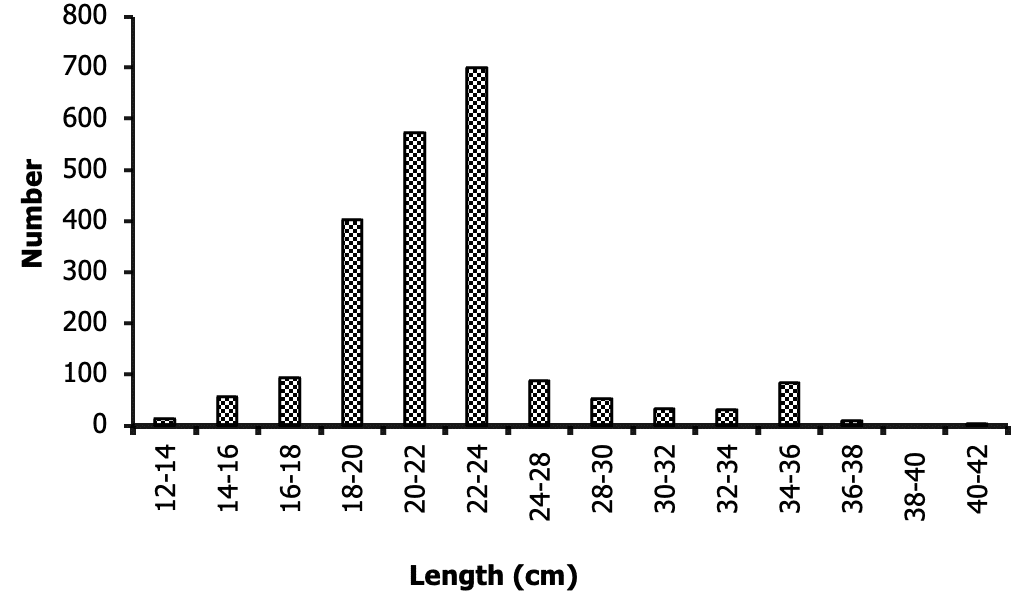
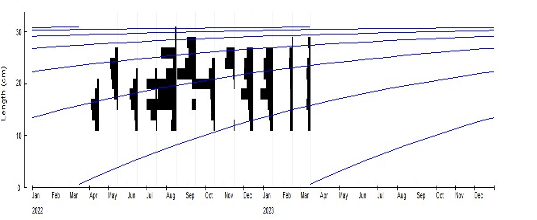
Table 1. Growth parameters in Sardinella maderensis of the coastal waters of Côte d’Ivoire from April 2022 to March 2023.
3.2 Instantaneous mortality coefficients (Z, M and F) and current exploitation rate (E)
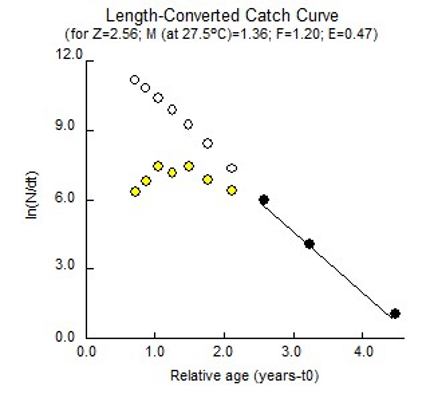
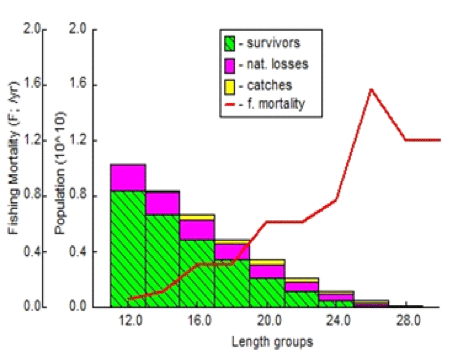
Total mortality (Z), natural (M) and Fishing (F) mortalities were estimated at 2.56, 1.30 and 1.20 year -1 respectively (Figure 4). The current exploitation rate of the species was 0.47.
3.3 Probability of capture and age at first capture
The Lc50 was estimated to be 23.75 cm, while the Lc25 and Lc75 were 21.88 cm and 25.65 cm, respectively. The age at first capture was estimated to be 1.95 years (Figure 5; Table 2).
3.4 Length and age at first sexual maturity
The length and the age at first sexual maturity were 21 cm and 1.478 year respectively (Table 2).
3.5 Recruitment trend
Recruitment in S. maderensis in the coastal waters of Côte d’Ivoire is illustrated in Figure 6. This phenomenon occurs throughout the year, with two major peaks in June and October. The length at first recruitment (Lr50) is 12 cm, corresponding to an approximate age at first recruitment of 0.59 years, or about six months (Table 2).
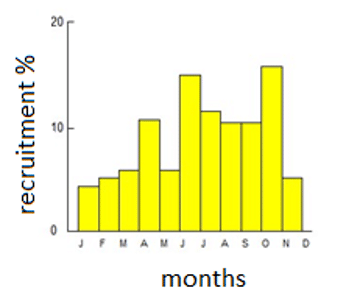
Table 2. Length and age at first capture, first sexual maturity and first recruitment in Sardinella maderensis of the coastal waters of Côte d’Ivoire.
3.6 Stock status
The current exploitation rate of S. maderensis is estimated at E = 0.47, which is lower than the threshold value of 0.5 but higher than the maximum exploitation rate (Emax=0.42). Additionally, this exploitation rate exceeds both the marginal exploitation rate (E0.1) and the economic exploitation rate (E0.5) (Figure 7). Furthermore, natural losses and the survivability of the fish population decrease with increasing length and fishing mortality (Figure 8).
4. Discussion
Size-related aspects, notably the maximum size observed in catches and the asymptotic length in this study, differed from previous studies conducted in the coastal waters of Côte d’Ivoire. These differences can likely be attributed to the fishing location, sampling methods, and, most importantly, the fishing gear used. The significance of the sampling method cannot be overstated, as it can result in catches that are not representative of the exploited population. The fish size range observed in a study is influenced by the sampling methods employed (Van Den Avyle et al., 1995). This variation is primarily due to the diversity of fishing gear used in the current study. Population estimates based on single-gear catches may lead to biased estimates of length–frequency or abundance in certain species (Clavero et al., 2006).
The asymptotic length recorded in this study was higher than the values reported for the species in Ghana and Nigeria (Amponsah et al., 2019; Olopade et al., 2019). However, it was lower than the value documented in Liberia (Wehye et al., 2017). The maximum observed length in catches was approximately similar in both Côte d’Ivoire and Liberia. The growth performance index phi-prime was comparable to the value recorded in Liberia but higher than those noted in Ghana and Nigeria, respectively (Amponsah et al., 2019; Olopade et al., 2019). The growth rate K identified in this study was higher than those reported in Liberia, Ghana, and Nigeria (Amponsah et al., 2019; Olopade et al., 2019; Wehye et al., 2017). The K value obtained indicates that S. maderensis in Côte d’Ivoire’s coastal waters is a fast-growing species. Generally, slow growth in fish species is linked to inadequate environmental conditions, characterized by high density and limited resources (Allen and Hightower, 2010).
The length at first capture observed in this study was higher than the values reported in Liberia and Ghana (Amponsah et al., 2019; Wehye et al., 2017). The differences in the length at first capture could be attributed to the variety of fishing gears used, variability in authorized mesh sizes, and particularly the fishing zones. If fishing occurs in a nursery area, the catches will predominantly consist of juveniles, which may not be the case when fishing takes place far from such nurseries.
Table 3. Estimated growth parameters of Sardinella maderensis of Côte d’Ivoire’s waters compared to those of other countries. .
S. maderensis reaches sexual maturity at an age of 5 months and a length at first capture one month earlier, both occurring before the second year of their life. The calculated length at first sexual maturity is lower than the length at first capture, indicating that the fish mature before being caught by fishing gear. This information is essential for stock renewal, as S. maderensis in Côte d’Ivoire’s coastal waters has the opportunity to procreate before capture. Fish should have an Lc50 value greater than the length at first sexual maturity (Lm50) (Snedecor and Cochran, 1980). This allows fish to contribute to the sustainability of the species through procreation. The study shows year-round recruitment trends with two peak periods, which aligns with the double recruitment patterns exhibited by most tropical species (Pauly et al., 1982). The current exploitation rate is higher than the Emax value, indicating that the species is overexploited. Such results necessitate urgent management measures to maintain the sustainability of the fishery.
5. Conclusion
The length of the species ranged from 12 to 41 cm. Sardinella maderensis in Côte d’Ivoire’s coastal waters is a fast-growing, long-lived species with year-round recruitment. Individuals of this species have the opportunity to reproduce before being captured by fishing gear, based on the sizes at first capture and first sexual maturity. Biological reference points E, Emax, E0.1, and E0.5 indicate a level of exploitation that requires special attention from fisheries managers.
Acknowledgements
We would like to sincerely thank everyone who directly or indirectly contributed to improving the quality of this work. We do not forget the fishing communities for the welcome they kindly gave us during the sampling period.
Source of funding
This research was conducted without any financial support from governmental, non-governmental, or private funding agencies. The study was entirely self-funded by the authors, and no specific grants were received for this research, authorship, or publication.
Data availability
Data will be available upon request from the corresponding author.
Informed consent statement
No informed consent was required to conduct the study.
Conflict of interest
The authors declare no conflict of interest.
Authors’ contribution
Conceptualization, methodology, data curation, formal analysis, writing original draft: Coulibaly Bakari; Data collection: Coulibaly Bakari; Data analysis: Coulibaly Bakari and Sylla Soumaïla; Figure preparation and supervision: Kouamelan Essetchi Paul, Koné Tidiani and Joanny Tapé T.G. All authors critically reviewed the manuscript and agreed to submit final version of the manuscript.
