



Motivation is a fundamental factor influencing students’ learning experiences, academic engagement, and future career aspirations. Achievement motivation is commonly associated with three goal orientations: mastery goals, which emphasize developing competence and acquiring knowledge and skills; performance goals, which focus on demonstrating competence relative to others; and social goals, which emphasize interpersonal relationships and social acceptance (Lee et al., 2024). These orientations may shape how undergraduate students establish academic objectives, respond to challenges, and prepare for their future careers. Both intrinsic and extrinsic motivation contribute to students’ educational experiences, influencing their willingness to learn, persistence, and engagement with academic activities (Achuodho et al., 2026; Almulla et al., 2025). However, students’ motivation is not determined solely by individual characteristics; it may also be influenced by their residential environment, access to institutional resources, social relationships, and living conditions.
Housing is an important component of students’ university experiences because it provides the physical and social environment in which learning, personal development, and interpersonal interactions occur. Appropriate accommodation can contribute to students’ comfort, independence, security, and academic engagement. Previous research has highlighted the importance of residential environments in shaping students’ experiences and satisfaction with university life (Amole, 2009). Housing is also associated with broader living standards and human development, making accommodation an important consideration for students who relocate to pursue higher education (Navarez, 2017; Aluko, 2009). For many undergraduates, entering university involves living away from their families for the first time and adapting to unfamiliar social, cultural, and institutional environments. University residences may therefore serve not only as places to live but also as settings in which students develop independent living skills, establish friendships, and adjust to university culture (Khozaei et al., 2010).
The residential environment can influence students’ social adjustment, economic circumstances, and everyday learning experiences. Residential communities provide opportunities for interaction with peers from diverse backgrounds, participation in collective activities, and the development of interpersonal relationships. These experiences may help students improve their communication skills, adaptability, cooperation, and sense of belonging. The social and cultural characteristics of student residences can also influence behavioral expectations, interpersonal relationships, and students’ perceptions of university life (Najib and Yusof, 2009; Adesola and Arowolo, 2014). In addition, living with other students may encourage independence, mutual understanding, and the ability to negotiate shared responsibilities. Research on student residential environments has also highlighted the relevance of living conditions and shared facilities to students’ satisfaction and well-being (Karmakar et al., 2019). Consequently, housing arrangements may be relevant to students’ academic engagement and personal development, although the nature and extent of these relationships may vary across institutions and individual circumstances.
On-campus accommodation can provide students with relatively convenient access to classrooms, libraries, recreational facilities, and other university resources. Living close to academic facilities may reduce commuting time and provide additional opportunities for participation in educational and extracurricular activities. Students may also benefit from greater interaction with peers and access to institutional support. Residential proximity, however, does not automatically guarantee academic success or personal well-being. The quality of accommodation, availability of study spaces, privacy, cleanliness, safety, and management of residential facilities may affect students’ experiences. Inadequate facilities, overcrowding, limited resources, and demanding schedules can create stress and dissatisfaction among residents (Adesola and Arowolo, 2014; Perera, 2013). Accordingly, the potential benefits of on-campus accommodation depend partly on the quality of the residential environment and the support available to students.
Off-campus accommodation presents a different set of opportunities and challenges. Students living outside university residences may experience greater independence in managing their daily routines and personal responsibilities. However, they may also encounter difficulties associated with housing costs, transportation, safety, limited study facilities, and reduced access to campus-based activities. Long commuting distances and financial pressures may constrain the time and resources available for academic and social engagement. Previous research has identified socioeconomic, environmental, and psychosocial factors as important considerations in understanding differences in students’ living conditions and well-being (Guan et al., 2025). Similarly, Olufemi (2014) highlighted challenges associated with off-campus living, including accommodation affordability, study conditions, safety, and commuting. These challenges may influence students’ satisfaction with university life and their ability to balance academic responsibilities with personal and social commitments. Nevertheless, off-campus students’ experiences are likely to vary according to household circumstances, financial resources, residential quality, and proximity to their institutions.
In Bangladesh, access to suitable student accommodation is an important concern because higher education institutions enroll students from diverse geographical and socioeconomic backgrounds. Students who study far from their family homes may depend on university halls of residence or privately arranged accommodation. However, the availability and quality of institutional housing may not always correspond to students’ needs, potentially leaving some students dependent on off-campus alternatives (Roy et al., 2025; Jabar et al., 2012; Rutledge, 2012). Differences in accommodation arrangements may consequently influence students’ access to academic resources, opportunities for social interaction, and ability to manage living expenses. The transition to university life can also require students to adapt to new routines, shared living arrangements, and unfamiliar social expectations. Understanding these experiences is important for universities seeking to improve residential services and support students’ academic and personal development.
Despite the relevance of student accommodation to university life, the experiences of students living on campus and off campus should not be assumed to be uniform. Residential arrangements may offer different combinations of independence, institutional support, social interaction, convenience, and financial responsibility. These differences may be particularly relevant to students’ academic aspirations and perceptions of their future careers. Examining residential experiences through the perspectives of students can help identify the support systems and environmental conditions they consider important for their educational and personal development. In this study, four dimensions are emphasized: learning independence, social support, academic aspirations, and career development. These dimensions provide a framework for exploring how students perceive the opportunities and challenges associated with different housing arrangements.
Accordingly, this study compares undergraduates living in on-campus accommodation with those residing off campus at a public university. It examines their perceived experiences of residential living, the opportunities and difficulties associated with each arrangement, and the potential implications for academic engagement, social behaviour, personal development, and career aspirations.
This study addresses the following research questions, what challenges and opportunities do undergraduates experience in on-campus accommodation compared with off-campus accommodation? How do these housing arrangements relate to students’ academic experiences, social behaviour, personal development, and career aspirations? The study therefore aims to compare students’ residential experiences and examine the relationship between housing arrangements and their academic, social, personal, and career-related development. The findings may provide useful insights for university administrators and policymakers to improve accommodation facilities, strengthen student support services, and promote residential environments that support undergraduates’ educational and career aspirations.
2. Literature review
2.1 Residential environments and student motivation
Student motivation is an important factor in learning engagement, academic performance, and personal development. In higher education, motivation may be influenced by individual aspirations as well as the physical and social environments in which students live and study. Suitable accommodation can provide a supportive setting for learning, promote independence, and help students manage the demands of university life. Xu et al. (2025) highlighted the importance of residential facilities and social adjustment in students’ learning behaviour, academic development, and future career aspirations. Similarly, Amole (2012) discussed the role of university residences in meeting students’ basic needs and supporting their intellectual and emotional development. These findings suggest that residential environments should be considered an important part of the broader context of undergraduate education.
2.2 Housing conditions, affordability, and student well-being
The quality, affordability, safety, and suitability of accommodation are important considerations in students’ residential experiences. Ali et al. (2021) examined the experiences of students from rural Bangladesh adapting to urban university dormitories and identified concerns related to food quality, accommodation conditions, psychological distress, depression, and anxiety. The study also emphasized positive attitudes, social participation, and interpersonal connections as potential coping mechanisms. Iftikhar and Ajmal (2015) reported that students unable to access university accommodation often relied on privately arranged housing, which could be expensive or unsuitable. Concerns about housing and living expenses may create additional pressures and distract students from their academic responsibilities.
Residential preferences may also depend on room size, location, privacy, available services, and the quality of facilities. Dizaj and Khanghahi (2022) examined students’ residential preferences and identified accommodation characteristics relevant to their living experiences and perceived learning conditions. Cross et al. (2009) discussed residential security, economic considerations, student behaviour, and academic experiences in relation to university housing. Aluko (2011) likewise emphasized the importance of comfortable living environments for student satisfaction, convenience, well-being, and academic engagement. Collectively, these studies indicate that the potential benefits of student accommodation depend not only on availability but also on its affordability, quality, and suitability for students’ educational and personal needs.
2.3 Social adjustment, peer relationships, and personal development
University accommodation can provide opportunities for social interaction, cultural adaptation, and the development of independent living skills. Students living with peers may learn to share responsibilities, manage interpersonal relationships, and adapt to different social expectations. Ali et al. (2021) highlighted the importance of social participation and interpersonal connections in helping students adjust to unfamiliar urban environments. Amole (2012) also emphasized the role of residential settings in supporting students’ social and emotional experiences.
The wider social environment may influence students’ behaviour and adjustment. Gambo and Muktar (2017) discussed the influence of community conditions, peer groups, poverty, and social opportunities on young people’s behaviour. Vijila et al. (2013) highlighted the relevance of social environments and interpersonal relationships to the development of social skills. Bezuidenhout (2013) discussed the potential influence of peer pressure and group behaviour on individual conduct, while Ndakwa (2013) emphasized the role of peer interactions in social learning. Although these studies do not directly establish differences between on-campus and off-campus undergraduates, they provide a broader basis for understanding how social surroundings may shape students’ behaviour and personal development.
2.4 On-campus and off-campus housing and academic and career development
On-campus and off-campus accommodation may provide different opportunities and challenges for undergraduates. On-campus housing may offer convenient access to classrooms, libraries, university services, and peer networks. These conditions may facilitate participation in academic and extracurricular activities. However, the benefits may be limited when residential facilities are overcrowded, poorly maintained, or inadequate for students’ educational needs. Cross et al. (2009) discussed the relationship between residential conditions and students’ educational experiences, while Adu-Gyamfi et al. (2014) highlighted connections between student housing and social, behavioral, and academic well-being.
Off-campus accommodation may allow students greater flexibility and independence in managing their daily lives. Nevertheless, students may encounter challenges associated with housing expenses, safety, commuting distances, and limited study facilities. Olufemi (2014) identified these issues as potential difficulties for students living outside university accommodation. Such challenges may affect students’ time management, participation in university activities, and ability to balance academic and personal responsibilities.
Evidence concerning the relationship between housing arrangements and student development is not entirely consistent. Woru et al. (2024) investigated off-campus accommodation and students’ social behaviour, including independence, freedom, personal growth, and social interaction, and reported no significant relationship between off-campus housing and the social behaviour examined. This finding suggests that residential location alone may not explain differences in student outcomes. Individual circumstances, the quality of accommodation, institutional support, and social relationships may also be relevant. Furthermore, although residential experiences may relate to students’ academic motivation and career aspirations, these relationships should be examined empirically rather than assumed.
2.5 Research gap and hypotheses
Previous research has examined student accommodation in relation to residential satisfaction, housing conditions, social adjustment, well-being, and academic experiences. However, the cited literature does not provide a sufficiently consistent basis for determining whether undergraduates living on campus experience fewer housing-related challenges or achieve better academic outcomes than those living off campus in the context examined by this study. Further comparative evidence is therefore needed to understand students’ experiences and the potential relationship between housing arrangements, academic engagement, social behaviour, personal development, and career aspirations.
To address this issue, the present study compares undergraduates living in on-campus and off-campus accommodation at a public university. It focuses on housing-related challenges, academic experiences, and perceived opportunities for personal and career development. The study examines the following null hypotheses:
H₀₁: There is no statistically significant difference in housing-related challenges between undergraduates living on campus and those living off campus.
H₀₂: There is no statistically significant difference in academic performance between undergraduates living on campus and those living off campus.
3. Materials and Methods
3.1 Research design
This study adopted an exploratory, descriptive, mixed-methods research design to examine undergraduates’ experiences of on-campus and off-campus accommodation at the University of Rajshahi, Bangladesh. The mixed-methods approach combined quantitative and qualitative data to provide a broader understanding of students’ residential experiences, housing-related challenges, academic engagement, social adjustment, and perceived opportunities for personal and career development. Combining these approaches was intended to capture both measurable responses and participants’ perspectives on student accommodation (Cooper and Schindler, 2006).
3.2 Data sources and collection methods
Both primary and secondary data were used in this study. Primary data were collected through a questionnaire survey, focus group discussions (FGDs), and key-informant interviews (KIIs). The questionnaire survey was designed to gather information from undergraduates living in on-campus and off-campus accommodation. Responses were recorded using three categories: sufficient, balanced, and insufficient. In addition, three FGDs were conducted, comprising two groups of students living in on-campus accommodation and one group of students living in off-campus accommodation. Two KIIs were also conducted with a university hall provost and an educationist to obtain institutional and educational perspectives on student housing. Secondary data were obtained from books, published and unpublished journal articles, research papers, university records, government reports, institutional documents, and relevant official websites. These sources provided contextual information on student accommodation and higher education in Bangladesh.
3.3 Study area
The study was conducted at the University of Rajshahi, a public university in Bangladesh. The university was selected as the study site to examine differences in the residential experiences of undergraduates living in university-provided accommodation and privately arranged off-campus housing. The selection of the study area considered the broader context of public higher education in Bangladesh, where students from different geographical and socioeconomic backgrounds pursue undergraduate degrees. The study focused on undergraduate students residing in university halls and private accommodation outside the campus. This setting provided an opportunity to compare students’ perceptions of residential conditions, institutional support, social adjustment, academic experiences, and career-related aspirations within the same university environment.
3.4 Study population and sampling
The broader study population comprised undergraduate students enrolled at public universities in Bangladesh. According to the University Grants Commission, the reported undergraduate population across public universities was approximately 552,000, of whom approximately 176,520 were enrolled at the 16 general public universities identified in the study (UGC, 2023). The University of Rajshahi was selected as the specific study site, with an institutional student population of approximately 22,306 according to university records. The study targeted undergraduates living in on-campus and off-campus accommodation.
Student respondents were selected to represent both housing groups. The sample comprised 50 on-campus and 50 off-campus students. Each group included 40 male and 10 female students. The study also included two key informants: one hall provost and one educationist. Three FGDs were conducted to obtain additional perspectives from students in the two housing categories. The sampling approach was intended to facilitate a comparison between the residential experiences of on-campus and off-campus undergraduates.
3.4.1 Distribution of respondents
Table 1 presents the distribution of student respondents and key informants.
Table 1. Distribution of student respondents and key informants.
| Respondent category | Composition | Number |
| On-campus students | 40 male and 10 female | 50 |
| Off-campus students | 40 male and 10 female | 50 |
| Hall provost (KII) | A student hall of the university | 1 |
| Educationist (KII) | University of Rajshahi | 1 |
| Total listed respondents and key | 102 |
3.4.2 Conceptual framework
The process begins with the identification of factors influencing on-campus lodging, including location and accessibility, cost and affordability, safety and security, facilities and services, academic environment, and management and rules, alongside elements of off-campus housing, such as rental costs, commuting, roommates and social support, food and daily living, safety, and lease-related issues. These factors influence students’ hall-lodging motives, including academic focus, social interaction, safety, personal growth, comfort, convenience, and cost-effectiveness. Subsequently, motivation, support systems, peer influence, access to resources, and the study environment may shape students’ learning experiences and academic engagement. The process then examines whether lodging contributes to individual progress and career development, considering physical and psychological security, support from peers, mentors and staff, an inclusive environment, and a sense of belonging. Ultimately, the framework assesses the potential relationships between students’ accommodation experiences, learning processes, individual progress, and career development (Figure 1).
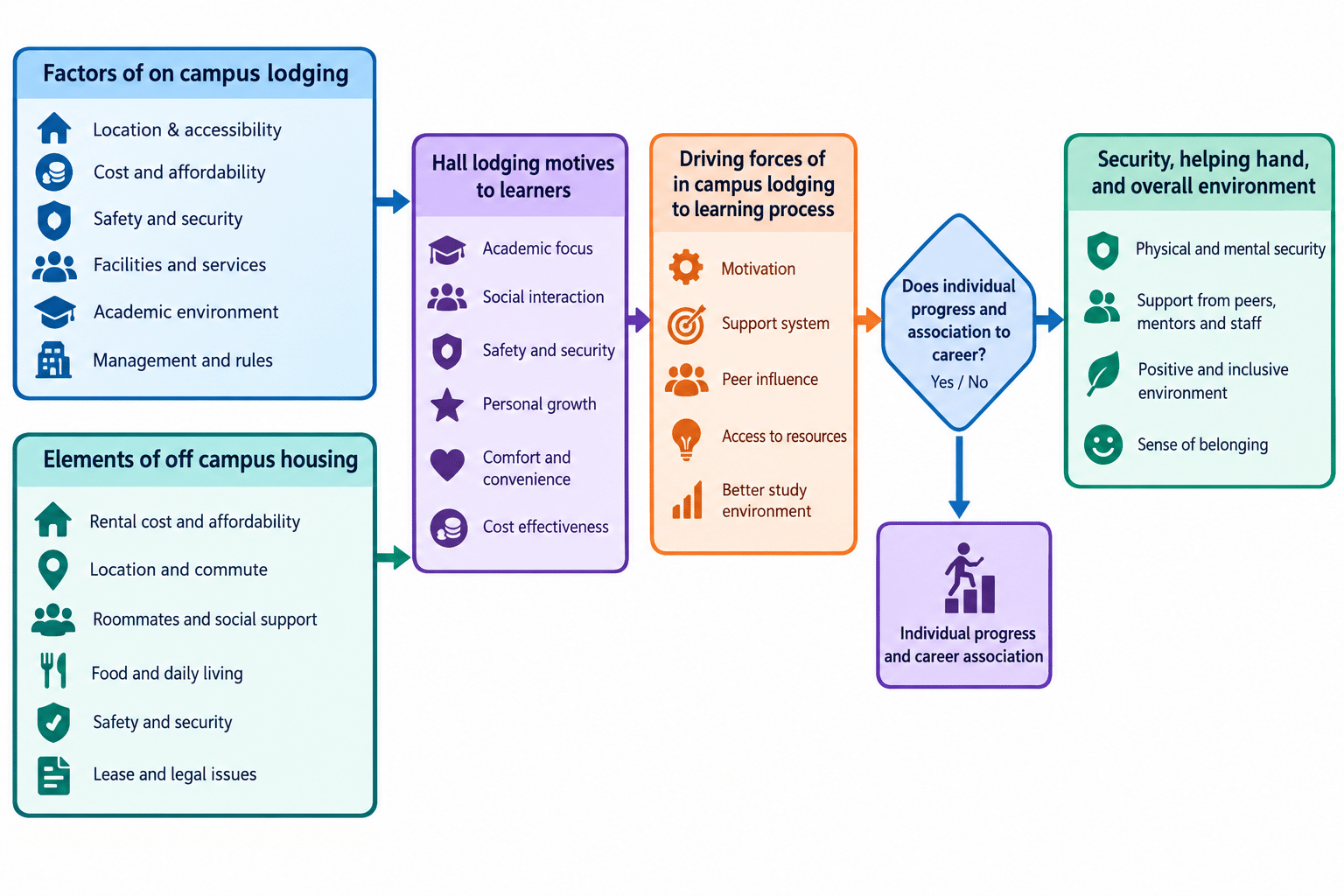
Figure 1. Conceptual framework illustrating the relationships between housing arrangements, residential conditions, student motivation, learning experiences, and perceived personal and career development.
3.4.3 Institutional profile of the University of Rajshahi
The University of Rajshahi was selected as the study site because it provides a setting in which undergraduates live in both university-managed halls and privately arranged accommodation. The institutional information supplied for the study is summarized in Table 2.
Table 2. Institutional profile of the University of Rajshahi.
| Institutional characteristic | Reported information |
| Faculties | 12 |
| Departments | 59 |
| Institutes | 6 |
| Academic programmes | Undergraduate, postgraduate, MPhil, and PhD programmes |
| Academic staff | Approximately 1,200 |
| International student residence | 1, designated for international students |
| On-campus residential halls | 17 reported: 11 for male students and 6 for female students |
| Total student population | 22,306 |
| Male students | 13,221 |
| Female students | 9,085 |
| Students living in on-campus accommodation | Approximately 10,000 |
| Students living in off-campus accommodation | Approximately 12,306 |
4. Results
4.1 Timing of access to on-campus accommodation
The survey examined when students obtained access to university-provided accommodation during their undergraduate studies. Overall, 20% of respondents obtained accommodation at the initial stage of their studies, while 40% gained access during the middle stage and another 40% before completing their studies (Table 3).
Table 3. Timing of access to on-campus accommodation among respondents.
| Timing of obtaining accommodation | Frequency (n) | Percentage (%) |
| Initial stage of study | 20 | 20.0 |
| Middle stage of study | 40 | 40.0 |
| Before completion of study | 40 | 40.0 |
| Total | 100 | 100.0 |
4.2 Monthly accommodation and living expenses
Monthly expenditure differed between students living on campus and those living off campus. Among on-campus residents, the largest group (42%) reported monthly expenses of BDT 4,000–5,000. Among off-campus residents, the largest group (48%) reported expenses of BDT 6,000–7,000. Overall, 43% of respondents reported monthly expenditure of BDT 4,000–5,000, while 39% reported expenditure of BDT 6,000–7,000 (Table 4). The distribution indicates that a larger proportion of off-campus residents fell within the BDT 6,000–7,000 expenditure category than on-campus residents (48% versus 30%). Similarly, 42% of on-campus residents and 44% of off-campus residents reported expenditure of BDT 4,000–5,000 (Table 4).
Table 4. Monthly expenditure of on-campus and off-campus students.
| Monthly expenditure (BDT) | On-campus, n (%) | Off-campus, n (%) | Total, n (%) |
| 3,000–4,000 | 8 (16.0) | 2 (4.0) | 10 (10.0) |
| 4,000–5,000 | 21 (42.0) | 22 (44.0) | 43 (43.0) |
| 5,000–6,000 | 6 (12.0) | 2 (4.0) | 8 (8.0) |
| 6,000–7,000 | 15 (30.0) | 24 (48.0) | 39 (39.0) |
| Total | 50 (100.0) | 50 (100.0) | 100 (100.0) |
4.3 Residential conditions, connectivity, communication, and food management
Respondents assessed residential conditions, internet facilities, communication, and food management using the categories sufficient, balanced, and insufficient. Among on-campus residents, 72% rated these conditions as balanced, 16% as sufficient, and 12% as insufficient. Among off-campus residents, 92% selected balanced and 8% selected sufficient; none selected insufficient (Table 5).
Table 5. Respondents’ assessments of residential conditions and related facilities.
| Assessment | On-campus, n (%) | Off-campus, n (%) | Total, n (%) |
| Sufficient | 8 (16.0) | 4 (8.0) | 12 (12.0) |
| Balanced | 36 (72.0) | 46 (92.0) | 82 (82.0) |
| Insufficient | 6 (12.0) | 0 (0.0) | 6 (6.0) |
| Total | 50 (100.0) | 50 (100.0) | 100 (100.0) |
4.4 Residential environment and perceived security
The survey also examined respondents’ assessments of the residential environment and overall security. Across all 100 observations shown in the table, 46% selected balanced, 36% selected sufficient, and 18% selected insufficient. Within the on-campus group, sufficient and balanced were equally common, each accounting for 34 of 80 observations (42.5%). Within the off-campus group, 12 of the 20 observations (60.0%) were classified as balanced and 6 (30.0%) as insufficient (Table 6). One female student described being followed and harassed while returning from a departmental seminar at approximately 9:30 p.m.
Table 6. Reported assessments of the residential environment and security.
| Assessment | On-campus, n (%) | Off-campus, n (%) | Total, n (%) |
| Sufficient | 34 (42.5) | 2 (10.0) | 36 (36.0) |
| Balanced | 34 (42.5) | 12 (60.0) | 46 (46.0) |
| Insufficient | 12 (15.0) | 6 (30.0) | 18 (18.0) |
| Total | 80 (100.0) | 20 (100.0) | 100 (100.0) |
4.5 Access to academic resources, social relationships, and learning opportunities
The final survey comparison addressed access to library facilities, relationships with teachers, interaction between senior and junior students, learning independence, social relationships, and communication related to academic activities. As reported, 54% of on-campus residents rated these opportunities as balanced, 22% as sufficient, and 24% as insufficient. Among off-campus residents, 92% selected balanced and 8% selected insufficient, while none selected sufficient (Table 7).
Table 7. Respondents’ assessments of academic and social opportunities by residence type.
| Assessment | On-campus, n (%) | Off-campus, n (%) | Total, n (%) |
| Sufficient | 11 (22.0) | 0 (0.0) | 11 (11.0) |
| Balanced | 27 (54.0) | 46 (92.0) | 73 (73.0) |
| Insufficient | 12 (24.0) | 4 (8.0) | 16 (16.0) |
| Total | 50 (100.0) | 50 (100.0) | 100 (100.0) |
4.6 Findings from key-informant interviews
Key-informant interviews (KIIs) were conducted with a hall provost and the director of the Institute of Education and Research at the University of Rajshahi. The interviews explored how residential arrangements may relate to students’ academic experiences, social development, personal independence, and career preparation.
The interview accounts identified several perceived advantages of on-campus accommodation. First, proximity to lecture halls, libraries, laboratories, and other university facilities may reduce commuting time and make participation in academic activities more convenient. Second, living alongside peers may facilitate collaborative learning, informal discussion, study groups, and mutual support during examinations. Third, interaction with teachers, senior students, and peers may help students obtain academic guidance and learn from others’ educational and professional experiences.
The informants also highlighted opportunities to participate in seminars, workshops, cultural programmes, debates, and sporting activities. Such involvement was viewed as potentially helpful for developing communication, teamwork, time management, and interpersonal skills. Residential communities were also described as possible sources of social connection and emotional support. Nevertheless, the informants acknowledged that the availability of university accommodation was insufficient to meet student demand and emphasized the importance of improving access, particularly during the early stages of undergraduate study. The interviews further suggested that students living off campus may experience additional challenges associated with commuting, participation in university activities, access to informal academic support, financial pressures, and personal safety. These concerns were considered particularly relevant for students living far from campus and for female students who travel after evening activities.
5. Discussion
5.1 Delayed access to university accommodation
The findings indicate that access to on-campus accommodation was often delayed. Only 20% of respondents reported obtaining accommodation at the initial stage of their studies, whereas 80% reported gaining access during the middle or later stages. This pattern highlights a potential mismatch between demand for university accommodation and available residential capacity. Previous research has emphasized the importance of providing suitable student accommodation to support residential satisfaction and students’ broader university experiences (Amole, 2009, 2012).
Delayed access may mean that students spend a substantial part of their undergraduate education arranging housing independently. Depending on their circumstances, this may involve additional commuting, financial responsibilities, and reduced opportunities for informal interaction with peers and university staff. Research on rural students attending urban universities in Bangladesh has similarly identified accommodation-related adjustment challenges and highlighted the importance of social connections and support networks in coping with residential difficulties (Ali et al., 2021). Nevertheless, the present survey did not directly test whether delayed accommodation affected grades, retention, or career outcomes. Such relationships should therefore be investigated rather than assumed. Universities could consider transparent accommodation-allocation procedures, needs-based prioritization, and phased expansion of residential capacity. Particular attention could be given to students who face substantial commuting, financial, or safety-related barriers. These measures would be consistent with the broader importance of aligning student housing provision with residents’ needs and expectations (Amole, 2009).
5.2 Living expenses and financial pressures
The expenditure distribution suggests that a greater proportion of off-campus respondents reported monthly expenses of BDT 6,000–7,000 than on-campus respondents. This may reflect the combined costs of rent, food, utilities, internet access, and transport. Previous research has identified accommodation affordability and the availability of suitable housing as important considerations for university students, particularly those who cannot access institutional residences (Iftikhar and Ajmal, 2015). However, the actual financial advantage of on-campus accommodation depends on the charges and services included.
These findings should not be interpreted as definitive evidence that on-campus accommodation is less expensive for every student. The survey does not provide a full itemized comparison of expenditure, and the reported ranges do not establish average costs or account for differences in household circumstances. Residential satisfaction and housing preferences can also reflect factors beyond direct expenditure, including facilities, services, and the suitability of the living environment (Dizaj and Khanghahi, 2022; Khozaei et al., 2010). Future research should compare rent, food, utilities, transport, study materials, and other recurring expenses using a consistent measurement framework. Such evidence would help universities assess the financial implications of accommodation policies and identify students who may need housing assistance.
5.3 Residential conditions and the quality of daily life
Most respondents classified residential conditions, connectivity, communication, and food management as balanced. This suggests that accommodation quality should not be judged solely by whether a student has a place to live. The adequacy of study spaces, sanitation, food services, internet access, and routine management may also shape the residential experience. Previous research has demonstrated that student residential satisfaction is associated with multiple physical, social, and management-related attributes rather than a single characteristic of the accommodation (Nimako and Bondinuba, 2013; Amole, 2009).
On-campus residents reported concerns relating to cleaning, dining arrangements, food quality, reading facilities, and the coordination of residential services. These issues may affect comfort and the suitability of the residential environment for study. Research on students’ adjustment to university dormitories in Bangladesh has also identified food quality and accommodation conditions as important challenges (Ali et al., 2021). Off-campus residents, meanwhile, described challenges related to rent, food preparation, household responsibilities, and relationships with landlords. Independent accommodation may provide greater autonomy, but it can also require students to devote time and resources to tasks that would otherwise be organized collectively.
The findings therefore point to the importance of improving the quality and management of both university and private accommodation. For university halls, priorities may include reliable cleaning, nutritious and varied meals, adequate study areas, stable internet access, and responsive complaint mechanisms. For off-campus residents, universities could provide information about housing options, tenant responsibilities, transport, and safety resources.
5.4 Residential environment, personal safety, and health support
Perceived security emerged as an important aspect of students’ accommodation experiences. Table 6 suggests that insufficient ratings were more common among off-campus observations than on-campus observations. Previous research on student housing has identified safety, residential facilities, and the surrounding environment as relevant dimensions of students’ accommodation experiences (Amole, 2012; Khozaei et al., 2010).
The qualitative accounts also identify relevant concerns, including personal safety while travelling, protection of belongings, overcrowding, and access to medical assistance. Research on residential environments has also highlighted the relevance of physical conditions, social density, and the management of student residences to residents’ experiences (Amole, 2009). The reported account of harassment experienced by a female student travelling back from a university seminar also draws attention to the possible risks associated with late travel. Although a single account cannot establish how widespread such incidents are, it illustrates why accommodation policy should consider students’ travel patterns and safety needs.
Universities could strengthen emergency communication, provide clear procedures for reporting harassment, improve access to health assistance, and review transport arrangements for students attending evening academic activities. Hall administrations could also assess emergency-response procedures and the accessibility of medical services outside normal working hours. These measures should be designed to support students regardless of where they live, while recognizing that the risks and resources available may differ between residential settings.
5.5 Academic engagement, social support, and personal development
The survey and interviews suggest that students perceive on-campus residence as offering opportunities for interaction with peers, teachers, and senior students, alongside convenient access to libraries, seminars, and extracurricular activities. Such opportunities may support informal learning, academic discussion, social integration, and the development of interpersonal skills. Earlier research has discussed the potential role of university residential environments in students’ social and personal development, while also indicating that the quality of the residential experience matters (Worsley et al., 2021; Cheng and Chan, 2019; Amole, 2012).
The KII accounts provide a plausible explanation for these perceptions: living close to university facilities can reduce practical barriers to participation, while residential communities may provide opportunities for collaborative study and mutual support. Research on student accommodation in Bangladesh has also highlighted the importance of social associations, friendships, and family connections as coping resources during the transition to university life (Ali et al., 2021). Participation in academic and extracurricular activities may help students develop communication, teamwork, time management, and networking skills that are relevant to future employment. These are potential pathways through which residential environments could contribute to students’ development, rather than outcomes demonstrated directly by this study.
Off-campus students may have fewer opportunities for spontaneous interaction or evening activities when distance, transport, cost, or safety limits participation. However, off-campus residence should not automatically be equated with academic or social isolation. Students may develop strong support networks through classmates, family members, community organizations, and other sources. Future studies should examine the actual frequency and quality of academic and social participation rather than infer these outcomes from residence type alone.
The findings also suggest that accommodation alone is unlikely to determine students’ academic success or career trajectories. Student motivation, socioeconomic circumstances, teaching quality, family support, academic preparation, and access to institutional resources may all play a role. Research on achievement motivation highlights the importance of students’ goals and orientations in shaping their engagement with learning (Achuodho et al., 2026; Huang et al., 2025; Budiongan et al., 2024). Accordingly, accommodation should be considered one element of a broader student-support system rather than an independent determinant of academic or career success.
5.6 Implications for institutional policy and future research
The findings have several practical implications for the University of Rajshahi and comparable public universities. First, the apparent delay in access to halls supports reviewing accommodation capacity and allocation procedures. Second, improving sanitation, food services, internet connectivity, study spaces, and emergency support could strengthen the quality of on-campus residence. These priorities are consistent with research identifying physical facilities, residential services, and management practices as important components of student housing quality (Nimako and Bondinuba, 2013; Amole, 2009). Third, universities could extend student-support services to off-campus residents through housing information, transport guidance, safety awareness, academic advising, and opportunities to participate in university activities.
The findings also highlight the value of providing academic and social opportunities that do not depend on living in a university hall. For example, accessible library hours, inclusive seminars, peer-mentoring programmes, and student societies may help reduce participation barriers for students who live off campus. Such initiatives would recognize that students’ residential preferences and needs vary, while ensuring that accommodation arrangements do not unnecessarily restrict access to the academic and social resources of the university (Dizaj and Khanghahi, 2022).
Several limitations should be considered when interpreting the findings. The study involved a relatively small sample. The analysis relies primarily on descriptive statistics and qualitative accounts. No inferential tests are reported to establish statistically significant differences, and the study does not directly measure academic performance, employment outcomes, or long-term career progression. Consequently, the evidence supports conclusions about respondents’ reported experiences and perceptions, rather than causal claims about the effect of housing on academic or career outcomes.
Future research should use a larger sample drawn from multiple universities and apply consistent measures of housing quality, expenditure, academic engagement, social support, and personal safety. Inferential statistical methods could be used to examine group differences, with appropriate adjustment for socioeconomic background, year of study, gender, commuting distance, and other relevant factors. Longitudinal research would be particularly valuable for determining whether accommodation experiences are associated with changes in academic performance, student retention, skill development, or employment outcomes over time.
6. Conclusions
Student housing is an important component of the university learning environment, with potential implications for students’ social interactions, academic engagement, personal well-being, and educational progress. The findings of this study highlight the distinct advantages and challenges associated with on-campus and off-campus accommodation, including differences in living expenses, residential conditions, perceived security, and access to academic and social opportunities. However, the descriptive findings do not establish a causal relationship between housing conditions and academic performance. Universities, governments, and other stakeholders should therefore priorities the provision of safe, affordable, accessible, and adequate student accommodation as part of broader efforts to improve the higher education experience. Given the limited availability of university-provided housing, private accommodation providers can play an important role in meeting students’ residential needs. Nevertheless, concerns regarding housing quality, essential facilities, rental affordability, and personal security highlight the need for effective standards, monitoring, and accountability. Collaboration among higher education institutions, government agencies, and private developers is essential to ensure that both on-campus and off-campus housing meet appropriate standards and support students’ academic participation, social development, and overall well-being.
