



The waste generated by aquaculture operations poses a substantial environmental threat, as significant amounts of uneaten feed, feces, and other organic matter are discharged into the water. This results in the deterioration of water quality, algal blooms, oxygen depletion, and disruption of aquatic ecosystems, raising concerns about the sustainability of aquaculture practices (Dauda et al., 2019). Studies indicate that only 25% of the nitrogen in feed intake is converted into animal tissue, with the excess nitrogen dissipating into the aquatic environment (Majhi et al., 2023). Consequently, researchers are focused on solutions that can mitigate the environmental effects of nitrogenous waste, especially given the exponential growth of the aquaculture industry (Wahyuningsih et al., 2015). Moreover, water scarcity is increasingly posing a significant challenge for aquaculture, necessitating the development of innovative technologies to address these issues (Khanjani and Alizadeh, 2024).
Current aquaculture practices employ three primary techniques for the removal of harmful nitrogen: algae-based photoautotrophic removal, immobilization by heterotrophic bacteria into proteinaceous microbial biomass, and chemo-autotrophic oxidation by nitrifying bacteria into nitrate (Ebeling et al., 2006). These techniques are sometimes combined into a single system. Biofloc technology (BFT) is a cost-effective and sustainable approach that utilizes nitrogenous waste from aquacultured organisms, along with uneaten feed, to produce a protein-rich diet (Huang et al., 2022). Introducing organic carbon sources into the system raises the C: N ratio (exceeding 10), thereby facilitating the proliferation of indigenous heterotrophic bacteria. These bacteria convert waste into microbial protein (Jatobá et al., 2017). Biofloc meal can efficiently replace fishmeal as a protein source in aquaculture feeds for fish and shrimp, while surplus conventional feed can be repurposed into biofloc to provide high-value supplementary nutrition (Tubin et al., 2023). In shrimp aquaculture, implementing biofloc can reduce traditional feeding rates by as much as 30% (Khanjani et al., 2023; Burford et al., 2004). The incorporation of microalgae (Chlorella sp.) has been shown to enhance biofloc quality and the growth performance of juvenile freshwater prawns (Macrobrachium rosenbergii) (Ekasari et al., 2021). A "green biofloc" refers to a specific type of biofloc in aquaculture systems characterized by a dominant microbial community of photosynthetic microalgae, resulting in a greenish hue of the water and creating a "green water" ecosystem that serves as a natural food source for aquacultured species (Doncato and Costa, 2023).
Biofloc technology (BFT) has been demonstrated to facilitate high-density production, improve water quality, and enhance the recycling of feed and protein within a single culture unit, making it an environmentally sustainable strategy and an effective tool for mitigating the impacts of climate change (Emerenciano et al., 2022). Additionally, the introduction of carbohydrates into the aquaculture system without substituting water leads to a reduction in the water's pH, attributed to the conversion of carbohydrates into lactic acid by various bacterial species. This conversion helps mitigate the spread and proliferation of infections, including Vibrio species (Ma et al., 2009). Furthermore, dried biofloc aggregates can be included in aquaculture diets as a protein source, in addition to being consumed as in-situ live food (Lee et al., 2017; Kuhn et al., 2016). Thus, the present study aims to determine the proximate composition of oven-dried biofloc aggregates taken from a “green biofloc” for (Macrobrachium rosenbergii) culture, in comparison to commercially available fish meal, as a potential viable replacement.
2. Materials and Methods
2.1 Ethical approval
No ethical approval is required for this study.
2.2 Biofloc harvest and processing
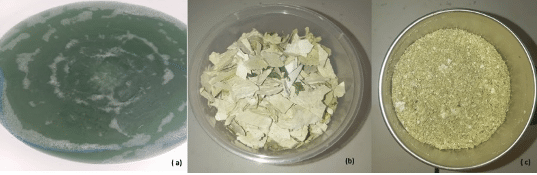
Green bioflocs were collected from two indoor tanks at the Curtin Aquaculture Research Laboratory (CARL) in Miri, Sarawak, Malaysia, where adult Macrobrachium rosenbergii were cultured (Figure 1a). The bioflocs were generated by supplementing molasses as a carbon source every 48 hours and exposing the tanks to continuous ambient sunlight. The rearing media were initially spiked with Chlorella spp. and nitrifying bacteria (Nitrobacter sp.,Nitrosomonas sp., and Lactobacillus subtilis) using commercial culture starters and carbon sources before stocking the prawns to facilitate the rapid growth of the biofloc. Once the bioflocs reached saturation, they were harvested. Aeration was stopped one hour prior to harvesting to allow for the natural flocculation of the aggregates. The bioflocs were collected using a plankton net (20 µm) to filter and gather the aggregates. The filtered biofloc materials were placed in airtight plastic containers and stored in a refrigerator at –4 °C until further processing. The chilled biofloc materials were spread onto metal trays and desiccated in a forced air circulation oven (Memmert UF110, Büchenbach, Germany) at 50 °C for 72 hours. The resulting dry film was removed from the trays, cut into small pieces (Figure 1b), and pulverized into powder (<100 µm) (Figure 1c) using an electric mill grinder (Orimas, DM350). The powdered biofloc materials were packed in airtight plastic containers and stored in a refrigerator at – 4 °C until analysis. <100 µm) (Figure 1c) using an electric mill grinder (Orimas, DM350). The powdered biofloc materials were packed in airtight plastic containers and stored in a refrigerator at –4 °C until analysis.
2.3 Proximate analysis
Proximate analysis was conducted on the prepared biofloc powder, with five samples prepared for each component analysis. This analysis involved determining the ash content, moisture content, crude protein content, and total lipid. The samples were evaluated for crude protein, crude fat, ash, fiber, and energy, following the methods outlined by AOAC (2016). The crude protein content was determined using the Micro-Kjeldahl method, while the crude lipid percentage was measured using a fat extraction system (Soxtec 2043, FOSS, Denmark). The ash content was assessed according to the method described by Harris and Marshall (2017). Crude fiber content was determined using a fiber analysis system (Fiber Cap 2022, FOSS, Denmark), and total energy was measured by combusting 1 g of the samples in a bomb calorimeter (Model Parr 6100, Moline, IL, USA).
2.4 Statistical analysis
All data were analyzed using SPSS version 26.0 (IBM Corp., Armonk, NY, USA). The proximate composition parameters (protein, lipid, ash, fiber, and energy) were expressed as means ± standard error (SE) for five replicates (n = 5). A one-way analysis of variance (ANOVA) was conducted to compare the proximate composition of dried green biofloc powder with that of commercial fish meal. Additionally, descriptive statistics were used to compare the results with previously published studies and assess trends in proximate composition across different biofloc types. All statistical tests were conducted at a significance level of α = 0.05.
3. Results and Discussion
The results show significant statistical difference in comparison between the values of the dried green biofloc powder and commercial fish meal with a high P-value (greater than 0.05) suggesting that the data is normally distributed. Notably, typical commercial fish meal contains between 60% and 72% crude protein (Miles and Chapman, 2006), whereas the average crude protein content found in the green biofloc powder in this study was only 27.53% (Table 1).
Protein content reported in previous biofloc studies has varied widely, ranging from 12.12% to 24.09% (Binalshikh-Abubkr et al., 2021), 37.93% to 38.41% (Azim and Little, 2008), and 9.59% to 13.7% (Neto et al., 2015). The relatively high crude protein content of the powdered green biofloc in this study, compared to values in other studies, can be attributed to the significant presence of the green algae Chlorella spp. While some species of algae have relatively low protein levels, many microalgae species cultivated in controlled conditions have been shown to contain high protein levels, typically 40% to 60% of dry matter. Research indicates that Chlorella spp. contains between 48% and 60% crude protein (Wang et al., 2021).
Table 1. Comparison of proximate composition of dried green biofloc powder and commercial fish meal powder expressed as (g/100 g dry matter basis).
The crude lipid content found in bioflocs is typically low, ranging from 0.35 to 0.9 g/100 g. However, these values are based on typical microbial bioflocs that do not include green microalgae (Binalshikh-Abubkr et al., 2021). The chlorophyta microalgae Chlorella spp.contains between 11% and 31% lipid content, depending on the species and culture conditions (Morales et al., 2021). This may explain the higher lipid content observed in the present study (5.28%) (Table 2) compared to previous studies, which reported lipid values of 0.35–0.92% (Binalshikh-Abubkr et al., 2021), 3.16–3.23% (Azim and Little, 2008), and 0.72–0.91% (Neto et al., 2015).
Table 2. Comparison of proximate composition of dried prawn biofloc powder results of some prior dried biofloc studies expressed as (g/100 g dry matter).
4. Conclusions
Most aquaculture species require an optimal protein level of 20-50 g per 100 g of their diets. Based on the general nutritional composition identified in the study, dried green biofloc powder may be suitable for completely replacing fishmeal in formulated diets for aquatic organisms, particularly those with lower dietary protein needs. It may also serve as a partial replacement for a wider variety of cultured aquatic species. Since these biofloc materials are essentially by-products of the culture process, they represent an economically feasible alternative to fishmeal. Further research is needed to evaluate their incorporation into formulated diets for aquaculture organisms, specifically regarding their suitability and palatability.
Acknowledgements
The authors wish to thank the International Development Research Centre (IDRC), Canada for their kind support.
Data availability statement
Data generated or analyzed during this study are available from the main and corresponding author upon reasonable request.
Informed consent statement
All study participants, provided informed consent prior to study.
Conflict of interest
The authors declare no conflict of interest.
Author contributions
Lirong Yu Abit: conceptualization, design, experiments, data analysis, writing-first draft of the manuscript; Natrah Fatin Mohd. Ikhsan: writing, editing, and reviewing; Muhammad Fadhil Syukri Ismail: writing, editing, and reviewing; Kamil Latif: writing, editing, and reviewing. All authors critically reviewed the manuscript and agreed to submit final version of the article.
