



Bangladesh’s rapidly growing population and urbanization have intensified the demand for fish, urging the aquaculture sector to innovate and adopt more sustainable and efficient production methods (Haque and Mahmud, 2025). Traditional pond-based fish farming, while widely practiced, faces constraints such as limited land availability, water quality degradation, and challenges in increasing stocking density without compromising fish health (Mehrim and Refaey, 2023; Jahan et al., 2010). These limitations necessitate the adoption of modern aquaculture technologies that can sustainably boost productivity to meet future food security demands.
One such promising innovation is the in-pond raceway system (IPRS), a highly advanced aquaculture method designed to optimize fish growth through controlled environmental conditions. The IPRS consists of raceways or channels constructed within a pond that facilitate high-density fish culture under continuous water circulation (Minahal et al., 2024; Fantini-Hoag et al., 2023). This mechanized system maintains ideal water chemistry, particularly sufficient dissolved oxygen (DO) levels, by constantly pumping water through the raceways, creating a dynamic flow that mimics natural streams. Such continuous circulation enhances oxygen supply, removes metabolic wastes, and prevents the accumulation of harmful substances, thereby enabling intensive fish stocking densities far exceeding those possible in traditional pond culture. By maintaining a stable and healthy aquatic environment, IPRS has demonstrated potential to increase fish yields substantially while minimizing water usage and environmental impact (Boyd et al., 2018, 2020; Li et al., 2019).
IPRS technology has been successfully applied in Bangladesh with species such as Indian major carps, European carps, tilapia, and catfishes among others. The system supports year-round production through staggered stocking and harvesting, improving market supply and profitability for farmers (Brown et al., 2011). Pilot farms such as Nawab Matshya Khamar in Chapainawabganj and Afil Aqua Fish Ltd in Sharsha, Jashore have integrated IPRS with remarkable success, showcasing its potential to modernize aquaculture and address the dual challenges of land and water scarcity. Moreover, the efficient water use in IPRS reduces the need for frequent water exchange, making it an eco-friendly and climate-resilient option for the future of fish farming in Bangladesh (Vignesh et al., 2025).
While IPRS provides significant benefits, one of the main operational costs arises from maintaining water quality, which includes aeration, water exchange, and filtration. These processes often require mechanical equipment and energy, increasing production expenses and potentially limiting adoption by small- and medium-scale farmers (Fantini-Hoag et al., 2022; Li et al., 2019). To address this, integrating natural filter species—such as filter-feeding fish, mollusks, or aquatic plants—into the system has emerged as an innovative strategy. Filter species improve water quality by biofiltration, consuming suspended organic matter and recycling nutrients, which can reduce reliance on costly mechanical filtration and aeration. This approach not only lowers operational costs but also supports ecological balance within the culture environment (Gupta et al., 2024; Zhang et al., 2011).
Despite its potential, limited research has explored the economic and ecological impacts of incorporating filter species into IPRS in Bangladesh. Critical questions remain regarding the effectiveness of different filter species in improving water quality, reducing production costs, and sustaining or enhancing fish growth and survival. Furthermore, understanding the cost-benefit trade-offs of such integrations is essential for developing practical recommendations tailored to the needs of local aquaculture practitioners.
The central hypothesis guiding this research was that the inclusion of filter species in IPRS would lead to significant reductions in operational costs by enhancing water quality naturally, thereby decreasing the dependence on artificial aeration and mechanical filtration. Additionally, it was hypothesized that filter species would not adversely affect the growth or survival of cultured fish but rather contribute to a more stable and self-sustaining culture environment. The study's findings are expected to offer valuable insights for improving the economic viability of IPRS technology in Bangladesh and similar tropical aquaculture settings. The research question we coined as, how effective are filter species in reducing operational costs and enhancing the economic viability of fish culture in IPRS in Bangladesh?
Considering the hypothesis and research question, this study was conducted to estimate the cost-benefit of integrating filter species in IPRS pond culture and assess their role in reducing production costs in IPRS cell systems. The study’s findings will inform aquaculture practitioners and policymakers about the economic advantages of incorporating filter species into IPRS, promoting more sustainable, cost-effective, and environmentally friendly fish farming practices. This can lead to improved profitability, reduced dependency on mechanical water treatment, and support the advancement of climate-resilient aquaculture in Bangladesh.
2. Materials and Methods
2.1 Ethical approval
No ethical approval was required to conduct the study.
2.2 Study area and duration
The experiment was conducted in both the IPRS cell and IPRS pond over a period of 120 days, from October 1 to January 31, 2022. Both systems are located at Afil Aqua Fish Ltd. in Sharsha, Jashore (Figure 1).2.3 Sample collection and identification

2.3 IPRS pond structure and management
2.3.1 Cell size
Four IPRS cells were constructed within a 5.51-acre (2.40 ha) pond. These channels, also known as raceways, were made of concrete and permanently fixed to the pond bottom. Fish were stocked and cultured inside these raceways. Each IPRS cell measured 22 meters in length, 5 meters in width, and 2.1 meters in depth, covering an area of 22 m × 5 m × 2.1 m.
2.3.2 Blower, aerator and power supply
Water circulation in the IPRS cells was maintained by four high-pressure air blowers, each with a power rating of 1.5 kW and a maximum airflow capacity of 210 m³/h (model no. 2JM510H26, China). The IPRS system also utilized a secondary power source, a diesel generator set with an output capacity of 80/100 KW/KVA and a voltage of 400 V (Model G-80KW, made in China).
2.3.3 White water unit
This unit, located at the start of the raceway, is the core of the IPRS system. It uses a high-powered airlift blower (2.2–2.5 kW) to push oxygenated water through the raceway, ensuring continuous water flow and aeration. This creates a stream-like environment, promoting natural fish movement and good health. The system includes multiple diffuser grids and delivers up to 230 m³ of airflow at 3 kPa pressure.
2.3.4 Bottom aeration system and waste collection system
The bottom of each cell has a separate and independent ventilation facility known as the bottom ventilation. The system also combines vertical ventilation with horizontal ventilation, which ensures booster ventilation throughout the system, making homogeneous water quality possible along the raceway. High-quality blower metal hose, PVC hose, bottom, and arrow tube ventilation tubing are part of this system (Figure 2).
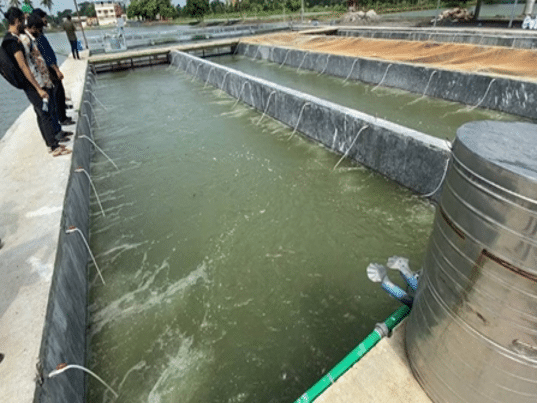
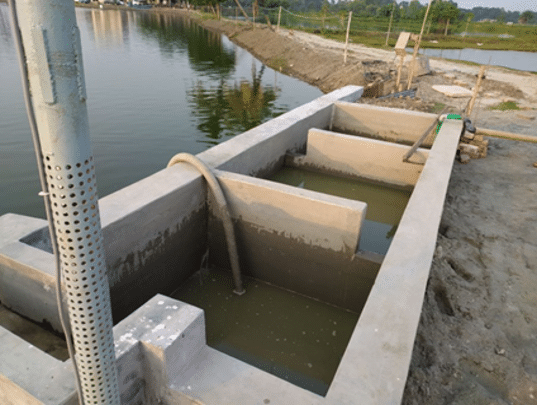
The waste collection unit, often referred to as the sludge unit, where all fish waste is collected and mechanically removed. It consists of a stainless steel cleaner, hose, and a drive mechanism. Waste from the raceway settles in this unit and is periodically extracted. The collected sludge can be repurposed as organic fertilizer for crop production (Figure 3).
2.3.5 Feeding system and strategy in IPRS cell
Automatic smart feeders were installed at the start of each raceway to ensure efficient and hygienic feed distribution, though manual feeding was occasionally used. Fish were fed four times daily at 9 AM, 2 PM, 6 PM, and 10 PM. Feeding rates were adjusted every 15 days based on fish sampling (at least 0.5% per cell) using a seine net. Feed was initially provided at 5.5–6.0% of body weight, gradually reduced to 3.0–3.5% by the end of the 120-day culture period. Fish growth and health were monitored biweekly using standard length and weight measurements.
2.4 Proximate composition of feed
The feed used in both IPRS cells and earthen ponds had pellet sizes of 2.0 mm (starter), 3.5 mm (grower), and 5.0 mm (finisher). Moisture was up to 11%, crude protein ranged from 31% to 27%, crude fat was 4%, fiber 7%, ash 10%, and energy ranged from 2800 to 2700 kcal/kg across the stages (Table 1).
Table 1. Proximate composition of the feed used in the IPRS cells.
2.5 IPRS pond preparation and management
The experimental pond used in this study was a conventional earthen pond with minimal water circulation, encompassing an area of approximately 2.26 hectares. It was located adjacent to the IPRS cell units within the premises of Afil Aqua Fish Ltd., Sharsha, Jashore, Bangladesh. To maintain optimal water quality, particularly DO levels, a mechanical aerator was installed and operated throughout the culture period.
2.6 Sampling for growth and health examination
Fish sampling was conducted at 15-day intervals throughout the culture period to monitor growth performance and assess overall health status. The number of fish sampled during each interval varied depending on their size and developmental stage. Standard morphometric parameters, including total length and body weight, were measured using a measuring board and a digital electronic balance. All handling procedures during sampling were performed with care to minimize stress and avoid injury to the fish.
2.7 Physicochemical parameters of water
2.7.1 Water temperature (°C)
Water temperature in both ponds was recorded every 15 days throughout the study period using a digital multi-parameter meter (Model No. HI9814, Hanna Instruments, Romania) (Table 2).
2.7.2 pH monitoring
The pH levels of the water in both the IPRS cells and pond were recorded at 15-day intervals using a digital multi-parameter meter (Model No. HI9814, Hanna Instruments, Romania). Before each measurement, the electrode was thoroughly rinsed with distilled water to ensure accuracy (Table 2).
2.7.3 Dissolved oxygen (DO) (mg/L) monitoring
DO levels in both the IPRS cells and pond were measured at 15-day intervals using a DO meter (Lutron, DO-5509) (Table 2).
2.7.4 Measurement of water transparency
Water transparency was measured using a Secchi disc. The disc was lowered into the water until it was no longer visible to the naked eye, and the depth at this point was recorded in centimeters using a measuring scale (Table 2).
Table 2. Instruments used for the determination of water quality parameters in the experimental in IPRS cell and IPRS pond.
2.8 Harvesting and fish production and cost-benefit analysis
Final harvesting of fish was conducted at the end of the culture period, approximately four months after initial stocking. Harvesting took place early in the morning using seine nets. Immediately following harvest, species-wise fish production from both the IPRS pond and IPRS cells was recorded and estimated. In this study, detailed costs and benefits were evaluated based on fish production and expenses incurred over the 120-day culture period in both the IPRS cell and IPRS pond systems as outlined below,
2.8.1 Capital cost
Capital cost refers to the expenses incurred during the construction and setup of the hatchery.
2.8.2 Operating cost
Operating cost refers to the expenses required to run the hatchery operations, including labor, feed, and other day-to-day expenditures
2.8.3 Depreciation cost
Annual depreciation cost was calculated using the following formula (Rahman et al., 2022; Islam et al., 2016),

2.8.4 Total cost
Total cost was calculated, using the formula as follows (Rahman et al., 2022; Islam et al., 2016),
Total cost = operating cost + depreciation cost
2.8.5 Revenue income
The revenue income is the total sale during the experimental period.
Revenue income (BDT) = total production (kg) × unit price (BDT)
2.8.6 Net benefit
Net benefit was calculated by the following formula,
Net benefit (BDT) = total revenue income (BDT) – total cost (BDT)
2.8.7 Cost-benefit ratio
The cost-benefit ratio was calculated, using the formula as below,

2.9 Statistical analysis
The experimental results were analyzed statistically, incorporating both qualitative and quantitative approaches. Microsoft Excel 2013 was utilized for data calculations, table presentations, and graph preparation. The map of the study was prepared using ArcGIS 3.5.
3. Results
3.1 Water quality parameters
The average water temperature was slightly lower in the IPRS cell (25.51±4.04 °C) compared to the IPRS pond (26.50±3.73 °C). The pH levels were fairly similar, with the IPRS cell recording a mean of 7.94±0.26 and the IPRS pond 7.83±0.43. The DO concentrations were higher in the IPRS cell, averaging 6.55±0.23 mg/l, while the IPRS pond had a slightly lower mean DO of 6.06±0.56 mg/l. Water transparency, measured in centimeters, was greater in the IPRS cell (46.77±5.82 cm) than in the IPRS pond (39.84±3.93 cm), indicating clearer water conditions within the cell system (Table 3).
Table 3. Water quality parameters recorded from IPRS cell and IPRS pond during the experiment.
3.1.1 Temperature (°C)
The mean temperatures were 25.51 ± 4.04 °C in the IPRS cell and 26.50 ± 3.73 °C in the IPRS pond, with no significant difference observed between the two systems (Figure 4). The highest temperature of 31.8 °C was recorded in October within the IPRS cell, while the lowest temperature of 20.3 °C occurred in December, also in the IPRS cell.

3.1.2 pH
In the IPRS cell, the pH ranged from 7.5 to 8.3, with a mean value of 7.94 ± 0.26, while in the IPRS pond, the pH varied between 7.0 and 8.2, averaging 7.83 ± 0.43 throughout the experimental period from October 1 to January 31 (Figure 5).

3.1.3 Dissolved oxygen (mg/l)
The mean DO level was 6.55 ± 0.23 mg/L in the IPRS cell and 6.06 ± 0.56 mg/L in the IPRS pond. Overall, the DO concentration was consistently higher in the IPRS cell compared to the pond (Figure 6).

3.1.4 Transparency (cm)
During the observation period, the mean water transparency was recorded as 46.77 ± 5.82 cm in the IPRS cell and 39.84 ± 3.93 cm in the IPRS pond (Figure 7).

3.2 Cost-benefit analysis of IPRS cell
3.2.1 Capital and monthly depreciation costs in IPRS cell
For the construction of the IPRS cell and associated ponds, land was leased for a 50-year period at a cost of BDT 9,000,000. An additional BDT 7,109,885 was invested in setting up the in-pond raceway cell complex. This brought the total capital cost to BDT 18,198,285. Based on this investment, the annual and monthly depreciation costs were calculated to be BDT 434,217.4 and BDT 36,169.8, respectively (Table 4). The monthly depreciation cost is influenced by the total capital investment and the estimated useful life of the project—shorter project lifespans result in higher monthly depreciation expenses. Accordingly, the monthly capital cost per IPRS cell was BDT 9,042.44.
Table 4. Estimated capital investment and depreciation costs for four IPRS cells.
3.2.2 Total operating costs in IPRS cells
The fixed operating costs included expenses such as labor salaries, electricity, medicines, netting, and fertilizers. These costs remained constant across all species. Among the cultured species, the highest operating cost was recorded for Magur (BDT 2,480,700), while the lowest was observed for Grass carp (BDT 490,555) (Table 5).
3.2.3 Total cost in IPRS cell
The total production cost was calculated by combining the operating and depreciation costs. Among the species cultured, Magur incurred the highest total cost at BDT 2,489,742, while Grass carp had the lowest at BDT 499,597 (Table 6).
Table 5. Operating costs incurred for four fish species (Rui, grass carp, Shol, and Magur) cultured in IPRS cells over a four-month period.
Table 6. Total production cost of Rui, Grass carp, Shol, and Magur cultured in IPRS cells.
3.2.4 Total operating costs in IPRS pond
The operating costs encompassed expenses for seeding, feeding, harvesting, transportation, and electricity. Among the species, Silver carp incurred the highest operating cost of BDT 142,505, while Rui fish had the lowest at BDT 69,670. This difference is primarily attributed to the varying costs of fish seed (Table 7).
Table 7. Total operating costs for Rui, Catla, Silver carp, and Tilapia production in the IPRS pond.
3.2.5 Total production in IPRS cell
At the end of the 120-day culture in the IPRS cell, magur showed the highest production at 29,700 kg, with a stocking density of 200,000 fish (10 g each) and a harvest size of 150 g. Grass carp produced 12,488 kg from 9,000 stocked fish (340 g), harvested at 1,400 g. Shol yielded 16,113 kg from 24,862 stocked fish (300 g), harvested at 655 g. Rui produced 10,320 kg from 13,000 stocked fish (300 g), harvested at 800 g. The total production of all four species was 68,621 kg (Figure 8).

3.2.6 Total production in IPRS pond
In the IPRS pond, the main fish species cultured were rui, catla, silver carp, and tilapia, all fed naturally on plankton without supplementary feed. After 120 days, tilapia had the highest production at 9,850 kg, with a stocking density of 1,000 fish (50 g) and a harvest size of 1,000 g. Rui produced 3,234 kg from 3,000 stocked fish (180 g), harvested at 1,100 g. Silver carp yielded 6,501 kg from 2,200 fish (500 g), harvested at 3,000 g. Catla production was 3,234 kg with a stocking density of 800 fish (1,000 g) (Figure 9).

3.2.7 Total revenue income from IPRS cell and pond
The total revenue generated from the present study was BDT 15,068,275 in the IPRS cell and BDT 3,435,428 in the IPRS pond (Figure 10). Revenue was notably higher in the IPRS cell compared to the IPRS pond.

3.3 Net benefits analysis from IPRS cell and IPRS pond system
The net benefits from the experiment were BDT 9,978,388 for the IPRS cell and BDT 2,960,265 for the IPRS pond. These benefits were calculated by subtracting total costs from total revenue. When the IPRS pond was cultured alongside the cell, the combined net benefit increased to BDT 12,938,653 (Figure 11). Since the pond required no additional feed or fertilizer, the integrated IPRS cell with pond system proved more profitable than culturing fish in the IPRS cell alone.

3.4 Cost-benefit ratio
The estimated cost-benefit ratios after the 120-day culture period were 1.97 for the IPRS cell and 6.23 for the IPRS pond. When the pond was cultured together with the cell, the cost-benefit ratio increased to 2.34 (Figure 12).

4. Discussion
Maintaining good water quality is crucial for the survival and optimal growth of cultured fish. Appropriate ranges of key water quality parameters support effective management of both aquatic organisms and their environment. In this study, only slight fluctuations were observed in water temperature, pH, and DO levels between the two culture systems—IPRS cell and IPRS pond—during morning measurements.
In this study, water temperature ranged from 20.30 °C to 31.80 °C in the IPRS cell and from 20.30 °C to 31.50 °C in the IPRS pond, with average values of 25.51 ± 4.04 °C and 26.50 ± 3.730 °C, respectively, over the 120-day culture period. These temperature levels fall within the optimal range between 26.06 °C and 31.97 °C are generally suitable for aquaculture (Boscolo-Galazzo et al., 2018). Similarly, other studies observed surface water temperatures ranging from 30.20 °C to 34.0 °C in carp polyculture systems, and 20.5 °C to 30.5 °C in pond conditions. The values observed in the present study align well with these findings, indicating that the thermal conditions in both the IPRS cell and pond were conducive for fish growth throughout the study duration. Water temperature plays a pivotal role in determining the physical, chemical, and biological conditions of an aquatic ecosystem. It significantly influences the metabolism, feeding behavior, reproduction, and overall growth performance of fish (Boscolo-Galazzo et al., 2018). In fact, for many warm-water species, metabolic rates can double with just a 1 °C increase in temperature, with optimal metabolic activity typically occurring between 30 °C and 35 °C. However, abrupt temperature fluctuations, even within a species' tolerance range, can induce stress and negatively impact fish health. While low water temperatures are generally not problematic for fish farming in Bangladesh, extremely high temperatures—especially in shallow or turbid waters—can lead to fish mortality (Silva-Garay and Lowe, 2021).
In the present study, the pH values ranged from 7.5 to 8.3 in the IPRS cell and 7.0 to 8.4 in the IPRS pond, with mean values of 7.94 ± 0.26 and 7.83 ± 0.43, respectively, over the 120-day culture period. These values are well within the acceptable range for freshwater aquaculture. Previous studies have reported that a pH range of 6.5 to 9.0 is suitable for fish culture, with optimal productivity often observed between 7.5 and 8.5 (Awal et al., 2025). The pH values recorded in this study (mostly between 7.6 and 8.2) support the findings of earlier research, indicating favorable conditions for fish growth in both the IPRS cell and pond systems (Rahman et al., 2022).
In the present study, DO levels ranged from 6.2 to 6.9 mg/L in the IPRS cell and from 5.3 to 7.5 mg/L in the IPRS pond, with corresponding mean values of 6.55 ± 0.23 and 6.06 ± 0.56 mg/L over the 120-day culture period. These values indicate that both systems maintained suitable oxygen conditions for fish culture. Previous studies, had reported DO ranges between 2.2 and 7.1 mg/L. According to standard aquaculture practices, a DO concentration of 5.0 to 7.0 mg/L is considered fair to good for fish productivity, with levels above 5 mg/L generally recommended for optimal pond performance (AbuDalo et al., 2021; Ahmed and Ahmad, 2020). DO is one of the most crucial water quality parameters in aquaculture, as it directly affects fish respiration, metabolism, feeding, and overall health. Maintaining DO at optimal levels is essential for successful fish culture, as fluctuations can lead to stress, reduced growth, or even mortality. Variations in DO levels are often influenced by factors such as the rate of photosynthesis, respiration by aquatic organisms, and the decomposition of organic matter (Lindholm‐Lehto, 2023).
In the present study, water transparency ranged from 37 to 57 cm in the IPRS cell and 35 to 47 cm in the IPRS pond, with mean values of 46.77 ± 5.82 cm and 39.84 ± 3.93 cm, respectively, over the 120-day culture period. The higher transparency observed in the IPRS cell compared to the pond suggests improved water clarity, likely due to better water circulation and waste management in the IPRS design. This aligns with findings from other studies, where transparency ranged from 20 to 30 cm during April to June, indicating higher turbidity and organic load (Su et al., 2025). Transparency is a key indicator of water quality in aquaculture systems, as it reflects the level of suspended particles, including plankton, organic matter, and inorganic sediments. Higher transparency generally indicates lower turbidity and better water quality, which contributes to healthier culture conditions for fish. It also provides insight into nutrient loading and algal abundance, which are critical factors in pond productivity and ecosystem balance (Yusoff et al., 2024). Research also suggests that the presence of benthivorous fish and inorganic suspended solids can significantly affect Secchi depth, with biomass levels of 600 kg/ha capable of reducing transparency to 40 cm even in the absence of algal blooms. In contrast, reduced planktivorous fish densities can promote greater zooplankton abundance, improving water clarity by controlling phytoplankton populations (Zambrano et al., 2001).
The present study demonstrated the economic viability of the IPRS in Bangladesh, with a cost-benefit ratio of 1.97 and a net profit of BDT 99,78,388 over a 120-day culture period. The total cost incurred was BDT 50,53,517, and the total fish production reached 68,621 kg. These results underscore the profitability of IPRS technology when properly managed, particularly in high-density stocking systems where water quality and resource efficiency are maintained. The profits ranging from $9,772 to $15,688 per pond when the IPRS unit area was aligned with the recommended stocking density of 2.47 cells/ha (Khalil and Nasr-Allah, 2025). These values, when converted, range from BDT 10,10,511 to BDT 78,26,805, which are consistent with the net returns observed in this experiment. However, it is important to note that the break-even price per pound to be higher for IPRS systems compared to traditional pond aquaculture due to the substantial initial capital investment—estimated at $113,279, or approximately $18,880 per acre (Brown et al., 2014).
In the present study, the cost of fish production in the IPRS pond was notably lower than in the IPRS cell, while still yielding significant economic returns. The cost-benefit ratio in the IPRS pond was calculated to be 6.23, with a net profit of BDT 29,60,265, a total production of 22,332.5 kg, and an overall production cost of only BDT 4,75,163. This high cost-benefit ratio indicates that, although the productivity per unit area is lower in ponds compared to IPRS cells, the minimal input requirements—particularly the absence of supplementary feed and mechanical aeration—result in greater profitability relative to cost (Rahman et al., 2022). The ratio obtained in this study suggests that using IPRS ponds, especially when integrated with IPRS cells, can significantly improve profitability. This improvement is likely due to better water quality management, optimal fish growth, and the utilization of natural feed sources in the pond, reducing reliance on costly inputs (Panthai and Kungwalsong, 2024).
The present experiment demonstrated that integrating IPRS cells with pond culture is more economically advantageous than operating IPRS cells alone. The combined system achieved a cost-benefit ratio of 2.34, with a net benefit of BDT 1,29,38,653 and a total cost of BDT 55,28,680 over the 120-day culture period. This significantly higher profitability can be attributed to the fact that fish cultured in the pond required no supplementary feed or additional inputs, yet contributed to the total yield and revenue, thereby enhancing overall system efficiency (Rahman et al., 2022). The total costs and net benefits of BDT 9,20,059 and 5,20,665 in IPRS cells, and BDT 3,52,679 and 69,473 in earthen ponds, respectively (Rahman et al., 2022). Their cost-benefit ratios were 1.66 for IPRS cells and 1.28 for earthen ponds. Compared to those results, the integrated system evaluated in the present study yielded a significantly better economic outcome, highlighting the added value of coupling IPRS cell operation with low-input pond culture.
5. Conclusions
The study, conducted over four months in Sharsha, Jashore, demonstrated that grass carp and magur are the most cost-effective species for culture in IPRS cells. The cost-benefit ratios for grass carp, rui, shol, and magur were all satisfactory. High-density aquaculture faces challenges such as ammonia toxicity, water pollution, and disease, but IPRS technology helps maintain ecological balance and addresses these issues. Given Bangladesh’s land and water limitations and climate change impacts, climate-smart IPRS offers a sustainable approach to boost aquaculture. Combining IPRS cell with pond culture can increase profits without additional costs, contributing to poverty reduction and employment opportunities.
Acknowledgements
The first author gratefully acknowledges the logistical support provided by Department of Fisheries and Marine Bioscience, Jashore University of Science and Technology, Bangladesh. No internal or external funding was received to conduct the study.
Data availability statement
All data are presented inside the manuscript.
Informed consent statement
Not applicable.
Conflict of interest
The authors declare no conflict of interest.
Author contributions
Sumaiya Pervez: conceptualization, technique, research, formal analysis, original draft writing, review, and editing; Abdullah-Al-Mamun: formal analysis, writing, editing, and reviewing; Md. Emdadul Haq: formal analysis, writing, editing, and reviewing; Md. Atiqul Islam Mondal: writing, editing, and reviewing; Md. Aminur Rahman: conceptualization, supervising, writing, editing, and reviewing. All authors critically reviewed the manuscript and agreed to submit final version of the article.
