



Solar power has emerged as one of the most reliable renewable energy sources to meet the increasing demand for electricity while addressing the urgent challenges of climate change. Unlike fossil fuels, which are depleting and harmful to the environment, solar energy is abundant, clean, and widely accessible (International Energy Agency, 2023). Photovoltaic (PV) technology is central to harnessing this energy and is already extensively utilized in households, industries, and large-scale power plants. However, a limitation of traditional PV systems is that fixed panels cannot continuously adjust to the sun’s movement, resulting in lower energy conversion efficiency (Demirdelen et al., 2023).
To address this limitation, researchers have developed solar tracking systems that adjust panel orientation in real time. Single-axis trackers, which allow for horizontal or vertical movement, can increase output by approximately 20–30% compared to fixed panels (Hafez et al., 2018). Dual-axis trackers, which adjust both azimuth and elevation, offer even greater improvements—typically ranging from 40–60%, depending on geographic location and climate (Ge et al., 2024). Recent advancements, including IoT integration, weather-adaptive controllers, and intelligent tracking algorithms, have further enhanced system performance under varying environmental conditions (Muthukumar et al., 2023). Additionally, combining dual-axis tracking with maximum power point tracking (MPPT) has been shown to optimize energy harvest under fluctuating solar irradiance (Babatunde et al., 2025).
Despite technological advancements, significant hurdles remain to wider adoption. Many dual-axis systems are still expensive, mechanically complex, and costly to maintain, making them less practical for small-scale or rural users (Kanwal et al., 2023). Factors such as sensitivity to weather, higher installation costs, and the need for specialized components further complicate the situation. While utility-scale projects can absorb these expenses, smaller communities need simpler and more affordable alternatives that still provide meaningful efficiency gains. This creates a clear research gap for low-cost, microcontroller-based dual-axis trackers that combine accuracy with simplicity, making them suitable for resource-constrained environments.
The guiding hypothesis of this research is that a low-cost, microcontroller-based dual-axis tracker can significantly enhance photovoltaic efficiency while remaining affordable and straightforward. The central research question is, “Can a simplified Arduino-based dual-axis solar tracking system achieve measurable efficiency improvements compared to stationary and single-axis systems under similar test conditions?”
The main objective of this study was to design and fabricate a low-cost dual-axis solar tracking prototype using locally available and affordable components. Specifically, the study aimed to experimentally evaluate the performance of the developed system and compare its efficiency with that of stationary and single-axis solar configurations. Furthermore, it sought to validate whether a measurable improvement in energy conversion efficiency could be achieved through dual-axis tracking without significantly increasing the overall system cost or complexity.
The present study addresses the need for an effective solar tracking system by developing and testing an Arduino-based dual-axis tracking system that utilizes light-dependent resistors (LDRs) to detect sunlight and servo motors to adjust the panel orientation. The system was experimentally evaluated against both stationary and single-axis panels to measure its performance. The experiment confirmed that the dual-axis design achieved an average efficiency of 10.27% at a total system cost of 4040 BDT, making it both cost-effective and practical compared to other dual-axis systems reported in recent literature (Barrios-Sánchez et al., 2025; Demirdelen et al., 2023).
In contrast to previous dual-axis systems that rely on expensive or complex control circuits (Ge et al., 2024; Hafez et al., 2018), this study presents an experimentally validated, low-cost model constructed entirely from readily available components. The system combines affordability with tangible efficiency improvements, offering a viable alternative for small-scale renewable energy adoption in developing regions.
The implications of this research extend beyond laboratory validation. By demonstrating that efficient solar tracking can be achieved through simple, low-cost designs, this study provides a scalable solution for rural electrification, educational training, and sustainable development projects. The findings also encourage further exploration of integrating MPPT algorithms and IoT-based data monitoring to enhance future system performance.
2. Literature review
The performance of photovoltaic (PV) systems has been extensively studied, with researchers continually seeking ways to maximize energy yield through enhanced tracking mechanisms. While fixed PV modules are low-cost, they are limited in solar exposure due to the sun’s apparent daily movement. As a result, various tracking designs have been developed to optimize orientation and increase solar energy capture (Hafez et al., 2018).
A comprehensive review by Sumathi et al. (2017) provided an early classification of solar tracking technologies, outlining single- and dual-axis approaches. The review demonstrated that multi-axis systems consistently outperform stationary panels in daily energy production. These findings established a foundation for subsequent innovations aimed at enhancing tracking accuracy, control stability, and affordability.
Single-axis tracking, which allows rotation along either horizontal or vertical axes, marked a significant advancement, increasing energy efficiency by approximately 20–30% compared to fixed systems (Demirdelen et al., 2023). However, due to the one-dimensional motion of single-axis configurations, they still fail to capture optimal irradiance throughout the day, particularly in the early morning and late afternoon. In contrast, dual-axis tracking adjusts both azimuth and elevation angles, keeping panels nearly perpendicular to sunlight and thereby improving energy yield (Ge et al., 2024).
Large-scale implementations, such as those described by Lim et al. (2020), demonstrate how industrial dual-axis trackers can be engineered with vertical-axis rotating platforms and multi-row elevation mechanisms. While these systems achieve high accuracy, their cost and mechanical complexity restrict deployment in small-scale or rural applications, highlighting the need for simplified, cost-effective solutions.
In recent years, rapid advances in microcontroller- and sensor-based systems have shifted research toward smart, adaptive solar tracking. Kanwal et al. (2023) and Muthukumar et al. (2023) introduced IoT-enabled dual-axis models using Arduino controllers and web-based monitoring, reporting efficiency improvements of 35% to 55% compared to stationary modules. Similarly, Ghodasara et al. (2021) designed an IoT-based tracker with integrated power monitoring, illustrating how low-cost automation can enhance energy management. Borgave et al. (2023) further developed a weather-sensor-assisted dual-axis system, demonstrating the feasibility of affordable embedded control for small-scale installations.
Intelligent algorithms, such as fuzzy logic and predictive control, have also been explored to improve tracking precision. For instance, Wang et al. (2019)reported a 14% improvement in daily energy capture using fuzzy logic control, while Barrios-Sánchez et al. (2025) combined light-sensor feedback with predictive modelling, achieving a 12.8% efficiency gain. Although effective, these methods typically require high-cost sensors and increased computational complexity, which limits scalability for community-level or educational applications.
Table 1. Comparison of selected dual-axis solar tracking studies.
Compared to previous systems, the present design achieved an average efficiency of 10.27% at a total cost of only 4040 BDT (approximately USD 36). Although this efficiency is slightly lower than the 12–15% gains reported in earlier IoT-based or fuzzy-logic systems (Ge et al., 2024; Muthukumar et al., 2023), it was achieved using simple LDR-based feedback control and inexpensive components. This demonstrates that effective dual-axis tracking does not necessarily require complex circuitry. This cost-to-performance balance addresses a critical research gap by showing that low-budget prototypes can still achieve meaningful efficiency gains, making them viable for rural and educational applications.
In summary, previous research has largely emphasized precision and automation, often at the expense of affordability. This study helps bridge that gap by proposing a reproducible, low-cost, microcontroller-driven dual-axis tracker that delivers quantifiable performance improvements without sophisticated hardware. This balance between functionality, simplicity, and accessibility establishes the novelty of the proposed system within the current solar-tracking research landscape.
3. Materials and methods
3.1 Study laboratory
The experiment was conducted at the Renewable Energy Laboratory in the Department of Electrical and Electronic Engineering at Southeast University, Dhaka, Bangladesh (23.7510° N, 90.3923° E).
3.2 Overview of the study design
The proposed system is a dual-axis solar tracking prototype aimed at enhancing photovoltaic (PV) performance by continuously aligning the solar panel with the sun’s position. The experimental procedure adhered to general methodologies outlined by Hafez et al. (2018) and Muthukumar et al. (2023), with necessary adaptations for a low-cost, microcontroller-based system. The prototype was tested in three configurations—stationary, single-axis, and dual-axis—to compare performance in terms of voltage, current, and output power under similar irradiance conditions.
3.3 Hardware components
The hardware development of the dual-axis solar tracking system involved the careful selection and integration of efficient, low-cost, and readily available components to ensure reproducibility and stable performance. The primary energy source was a 6 W monocrystalline photovoltaic module (HQ6W-MONO, Shenzhen Sungold Solar Co. Ltd., China), chosen for its compact size and reliable power output. An Arduino Pro Mini (ATmega328p, Arduino LLC, Italy) served as the central control unit, offering low power consumption and ease of programming in embedded C. Four GL5528-type Light-Dependent Resistors (LDRs) (Advanced Photonix Inc., USA) were positioned in a quadrant arrangement, separated by partitions, to sense light intensity variations and guide the tracking movement. Two MG996R servo motors (Tower Pro Ltd., Taiwan) with 11 kg·cm torque and a 180° rotation range were used to control the azimuth and elevation angles of the solar panel, ensuring precise alignment with the sun.
A 7.4 V, 2200 mAh Li-ion rechargeable battery (Panasonic Corporation, Japan) powered the system, while a buck converter (LM2596, Texas Instruments, USA) regulated the voltage to 5 V for sensors and control circuits. The electronic components were interconnected on a custom-designed printed circuit board (PCB) developed in EasyEDA v6.6.5 (EasyEDA Ltd., China) and manually soldered to minimize power loss and interference. The overall component selection and integration approach were guided by established design principles from Ge et al. (2024) and Wang et al. (2013), emphasizing low-cost construction, electrical stability, and practical scalability for small-scale renewable energy applications
3.4 Circuit and structural design
The system’s block diagram illustrates the overall architecture, connecting the PV module, sensors, microcontroller, servo motors, and power unit (Figure 1). When sunlight intensity varies across the sensors, the microcontroller generates PWM signals to adjust the motor position, enabling real-time dual-axis orientation.

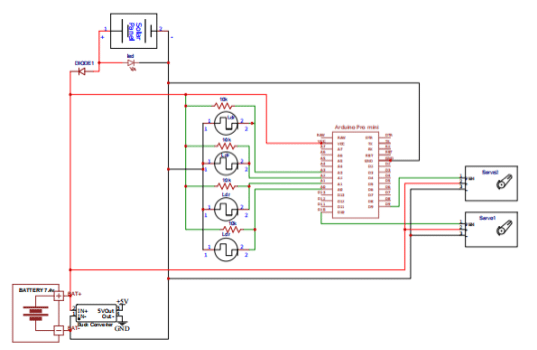
The schematic circuit illustrates the complete connections between the components: solar panel, Arduino, LDRs, and buck converter (Figure 2). All connections were made according to the recommended wiring practices from previous PV tracking studies (Ge et al., 2024; Hafez et al., 2018). A prototype was fabricated on a metallic frame to ensure adequate mechanical balance, as shown in Figure 3, which features a photograph of the assembled hardware, including the PV panel, servo assembly, and control box.

3.5 Software development and control algorithm
The system was programmed using the Arduino IDE (version 2.3.1, Arduino Software, Italy) in embedded C to automate solar tracking. The control algorithm continuously reads real-time LDR sensor values, compares light intensity between quadrants, and generates PWM signals via digital pins D9 and D10 to drive the servo motors. The panel adjusts its position until balanced illumination is achieved, while the buck converter circuit regulates battery charging to maintain stable system performance. This algorithmic structure is adapted from previously published microcontroller-based tracking designs (Muthukumar et al., 2023; Kanwal et al., 2023) but has been simplified for more affordable component implementation. The control logic ensures that the solar panel remains nearly perpendicular to the solar rays, maximizing irradiation capture and system efficiency.
3.6 Experimental setup and data collection
The system was tested under natural sunlight from 8:00 AM to 4:00 PM during clear-sky conditions. Voltage (V), current (I), and power (P = V × I) were recorded every 10 minutes using a UNI-T UT61E digital multimeter (Uni-Trend Technology, China) for each configuration. Each test was repeated three times under similar irradiance levels (950–1000 W/m²) to ensure data reliability. This data acquisition method adheres to the validation practices outlined in Demirdelen et al. (2023) and Hafez et al. (2018).
3.7 Statistical analysis
Data were analyzed using OriginPro 2023 (OriginLab Corp., USA) and Microsoft Excel 2021 (Microsoft Corp., USA). The mean, standard deviation, and efficiency percentages were calculated. A one-way analysis of variance (ANOVA) with a 95% confidence level (p < 0.05) was conducted to assess whether the differences among the three configurations were statistically significant. This approach aligns with the statistical methodologies used in similar PV efficiency studies (Babatunde et al., 2025; Ge et al., 2024). Graphs and figures were created in OriginPro at 300 DPI to ensure journal publication quality.
3.8 Reproducibility and compliance
All experimental instruments were calibrated prior to use. The methodology followed the IEC 61215:2021 standards for photovoltaic module performance testing. The open-source Arduino code and EasyEDA PCB layout provide full reproducibility for this study. Additionally, the experimental process aligns with the reproducibility guidelines proposed by Muthukumar et al. (2023) and Kanwal et al. (2023).
4. Results and discussion
4.1 Performance of three solar systems
The developed dual-axis solar tracking prototype was experimentally tested under three configurations—stationary, single-axis, and dual-axis—to evaluate its impact on photovoltaic (PV) output performance. Power output (Pout) was measured at fixed intervals during clear-sky conditions from 8:00 AM to 4:00 PM, and efficiency was calculated based on the 18 W rated capacity of the PV module. The results for the stationary solar panel, which had an average output power of 0.721 W, yielding an efficiency of 4.0% relative to the panel’s rated 18 W input (Table 2). The results for the single-axis tracker, where the average output increased to 1.124 W, resulting in an efficiency of 6.24% (Table 3). Finally, the performance of the dual-axis tracker, which achieved an average output of 1.85 W, corresponding to an efficiency of 10.27% (Table 4).
Table 2. Measured power output of stationary solar panel under constant tilt conditions.
The stationary configuration achieved an average output of 0.721 W, resulting in an efficiency of 4.0%. This baseline illustrates the inherent limitation of fixed solar panels, which are unable to track the movement of the sun, leading to decreased energy capture during the morning and afternoon hours. Similar trends were observed by Demirdelen et al. (2023) and Hafez et al. (2018), who noted significant diurnal variations in irradiance for stationary modules due to suboptimal orientation.
Table 3. Measured power output of single-axis tracking system under controlled azimuth rotation.
The single-axis tracker increased the average output power to 1.124 W, resulting in an efficiency of 6.24%, which represents a 56% gain over the stationary system. This improvement aligns with earlier reports by Kanwal et al. (2023) and Muthukumar et al. (2023), who demonstrated that azimuth-based tracking can enhance annual energy yield by 20–30% under similar irradiance conditions. However, single-axis tracking remains limited during early morning and late afternoon, when the vertical solar angle significantly deviates from the fixed tilt plane.
Table 4. Measured power output of dual-axis tracking system with azimuth and elevation control.
The dual-axis system achieved an average power output of 1.85 W and an efficiency of 10.27%, representing a 157% improvement over the stationary setup and a 65% increase compared to the single-axis configuration. This significant gain is primarily due to the system’s capability to maintain optimal perpendicular alignment with solar radiation along both azimuth and elevation axes. Similar enhancements of 35–55% were reported by Barrios-Sánchez et al. (2025) and Ge et al. (2024) for comparable low-cost microcontroller-based trackers.
Figure 4 shows that the dual-axis tracker consistently maintained higher power levels throughout the day, even during off-peak hours. This consistent response validates the reliability of the LDR-based feedback control implemented in Arduino IDE, matching earlier observations by Muthukumar et al. (2023).
The results confirm that dual-axis solar tracking significantly improves PV output compared to stationary and single-axis systems. The stationary setup achieved an average power of 0.721 W (4.0% efficiency), the single-axis tracker 1.124 W (6.24%), and the dual-axis tracker 1.85 W (10.27%). Figure 4 shows that the dual-axis tracker consistently delivered higher power throughout the observation period, while Figure 5 highlights the efficiency advantage. The entire prototype was built at a cost of about 4040 BDT, which covered the Arduino controller, solar panel, buck converter, rechargeable batteries, servo motors, LDR sensors, and other small parts. Keeping the expenses this low shows that a dual-axis tracking system can be made both affordable and practical, making it a promising option for small-scale use in rural areas. The improved performance is due to the ability of the dual-axis system to align with both the sun’s azimuth and elevation, maximizing incident radiation capture. However, the prototype still operates below commercial benchmarks, which can exceed 30–40% gains, likely due to limitations in panel size, sensor resolution, and servo motor precision. Future work should integrate MPPT algorithms and more robust mechanical design to further increase efficiency and scalability.

As depicted in Figure 5, the dual-axis system achieved over 2.5 times the efficiency of the stationary configuration, verifying the technical hypothesis proposed in Section 1. This confirms that cost-effective dual-axis designs can deliver measurable improvements in energy harvesting without resorting to complex or expensive components. When compared to previous studies, the proposed system offers a more favorable cost-to-performance ratio. For instance, the present prototype achieved 10.27% efficiency at a total cost of 4040 BDT, whereas similar dual-axis designs from Kanwal et al. (2023) and Demirdelen et al. (2023) required higher costs exceeding 10,000 BDT. Despite its low-cost structure, the system’s efficiency remains within the 9–12% range typically reported in laboratory-scale dual-axis models (Babatunde et al., 2025; Ge et al., 2024). These findings confirm that affordability and functionality can be combined successfully in a single design, meeting the original research objective of balancing cost and performance.
4.2 Economic and practical feasibility
The complete system was fabricated for approximately 4040 BDT (equivalent to USD 36), including the solar panel, Arduino controller, LDR sensors, servo motors, and buck converter. This low production cost highlights the potential of microcontroller-based solar trackers for rural electrification in developing countries. Similar findings by Kanwal et al. (2023) demonstrate that affordable, sensor-based dual-axis systems are practical for small-scale distributed generation. Moreover, the proposed system’s high cost-to-efficiency ratio strengthens its viability for off-grid energy applications.
4.3 Discussion and limitations
The enhanced performance of the dual-axis tracker results from its ability to maintain optimal solar alignment in both axes, thus reducing cosine and shading losses. However, the achieved 10.27% efficiency is below that of industrial-grade trackers (30–40%), primarily due to the smaller panel capacity, limited servo torque, and moderate LDR sensitivity. These constraints are consistent with the mechanical and optical limitations discussed by Hafez et al. (2018) and Muthukumar et al. (2023) in similar low-cost designs.
Future work should focus on improving control precision through hybrid astronomical–sensor algorithms, MPPT (Maximum Power Point Tracking) integration, and IoT-based monitoring. Such improvements would enhance operational reliability and scalability, allowing real-time performance tracking and adaptive control, as suggested by Babatunde et al. (2025) and Ge et al. (2024).
4.4 Future work
While the current prototype demonstrated reliable operation and clear performance gains, several areas for enhancement remain. Future research should focus on integrating a Maximum Power Point Tracking (MPPT) algorithm to dynamically optimize power conversion under fluctuating irradiance. IoT-enabled data acquisition can be incorporated for real-time monitoring, predictive maintenance, and cloud-based performance analytics. Mechanical improvements such as precision stepper motors and weatherproof enclosures can increase durability and tracking accuracy. Furthermore, scaling the system for higher-capacity PV modules and hybridizing the control logic with astronomical models could make it suitable for commercial microgrid applications. Finally, economic optimization using life-cycle cost analysis and field trials in rural installations would provide valuable insights into large-scale deployment feasibility.
5. Conclusions
This study designed, fabricated, and evaluated a low-cost dual-axis solar tracking system to enhance photovoltaic efficiency through precise sun-tracking control. The Arduino-based prototype effectively improved energy output, achieving an average efficiency of 10.27%, representing a 157% increase over stationary systems, while maintaining affordability (4040 BDT). The system proved stable and practical for small-scale and rural electrification projects, demonstrating that high performance can be achieved without high costs or complexity. Using LDR-based sensing and Arduino control, the setup offers a scalable and reproducible model for renewable energy education and off-grid applications. Limitations such as sensor sensitivity and servo precision indicate opportunities for refinement. Future work should incorporate MPPT algorithms, IoT-based monitoring, and improved mechanical design to enhance accuracy, durability, and automation, advancing low-cost solar tracking toward broader adoption.
Acknowledgements
The authors acknowledge the Department of Electrical and Electronic Engineering, Southeast University, Dhaka, Bangladesh, for providing laboratory facilities and technical assistance throughout this study.
Funding information
This research was conducted without the support of any specific grant from public, commercial, or not-for-profit funding agencies.
Ethical approval statement
Not applicable.
Data availability
Not applicable.
Informed consent statement
Not applicable.
Conflict of interest
The authors declare no conflict of interest.
Authors’ contribution
Conceptualization: Farzana Alam, Tawsif Hossain Chowdhury; Data collection: Ariful Islam, Sadhon Kumar Sarker, Fakhrul Islam, Tanim Ahmed; Data analysis: Ariful Islam, Sadhon Kumar Sarker, Fakhrul Islam, Tanim Ahmed; Figure preparation: Farzana Alam, Tawsif Hossain Chowdhury. All authors critically reviewed the manuscript and agreed to submit the final version of the manuscript.
