


Food security worldwide is threatened by unpredictable climate change and intensified degradation of soil fertility. One of the crucial challenges for agricultural productivity, particularly in tropical and subtropical countries, is soil nutrient deficiency (Baijukya et al., 2021). Intensive cultivation without proper restoration of essential macro and micronutrients has led to the continuous depletion of soil fertility and health (Rathi et al., 2024; Musa et al., 2024; Shahane and Shivay, 2021). Deficiencies in nutrients such as phosphorus (P) and boron (B) have emerged as significant issues in coarse-textured and highly weathered soils (Sagwal et al., 2023). The scarcity of these nutrients severely affects the productivity of legumes, which are often referred to as "poor man's meat." Legumes are the most important crops after staple foods, providing a substantial amount of essential nutrients and proteins (Banti and Bajo, 2020; Maphosa and Jideani, 2017). Among legumes, green gram (Vigna radiata L.) is a notable pulse crop in Bangladesh, where the cropping system primarily focuses on cereals (Islam et al., 2023). Green gram acts as a cornerstone for improving poor soil health through nitrogen fixation and serves as a low-cost source of protein in developing countries like Bangladesh (Aguilar et al., 2025). Additionally, green gram is highly valued for its short growing period and suitability for crop rotation systems (Banjara et al., 2022); however, its yield potential often falls short of expectations. This yield gap is primarily attributed to nutrient stress, particularly the insufficient availability of P and B in the root zone due to the indiscriminate use of chemical fertilizers. In tropical and subtropical regions, P fixation by iron and aluminum oxides renders P unavailable to plants, leading to deficiencies (Pang et al., 2024; Fan et al., 2019). Nutrient deficiencies in soil, such as insufficient phosphorus and boron, have resulted in inadequate root development, limited nodulation, delayed flowering, and reduced seed formation, ultimately leading to poor yields and quality of green gram. The productivity of green gram could be enhanced in both quantity and quality through improved P and B management.
Phosphorus is a crucial nutrient for plant energy metabolism, root development, and the fixation of biological nitrogen from the atmosphere (Khan et al., 2023). It plays a direct role in nodule formation and nitrogenase activity in legumes, such as mungbean, which are essential for maintaining sustainable productivity in subsequent crops (Meng et al., 2021). A sufficient supply of phosphorus enhances early root formation, promotes shoot growth, and increases the translocation of photosynthates between sources and sinks (Xiao et al., 2024). In contrast, phosphorus deficiency suppresses these physiological processes, leading to stunted growth and reduced biomass accumulation in plants (Khan et al., 2023). Furthermore, phosphorus is a vital component of ATP, nucleic acids, and phospholipids, all of which are necessary for cell division and growth (Zeng et al., 2025). Therefore, effective phosphorus management not only improves vegetative and reproductive growth but also enhances nutrient use efficiency and plant yield stability, even in low-fertility conditions.
Among the micronutrients, boron, although required in small amounts, is essential for plant growth and development. It plays a crucial role in processes such as cell wall synthesis, membrane maintenance, carbohydrate and RNA metabolism, sugar transport, and reproductive functions like pollen germination and pod setting (Vera-Maldonado et al., 2024). In legumes, boron is particularly important for nodulation and nitrogen fixation, as it ensures the stability of structures and functions in nodular tissues, making it critical during boron deficiency (Quijada et al., 2022). Typically, boron deficiency reduces shoot and root biomass production, leads to flower loss, hinders pod development, and causes early flower drop and increased pod abortions (Song et al., 2023). Despite its essential role, boron fertilization is often neglected in conventional fertilizer management, resulting in hidden hunger that constrains crop production. Therefore, nutrient management plans should include boron to achieve optimal productivity in green gram.
The combined application of phosphorus and boron may have synergistic effects on plant growth and yield attributes. Phosphorus enhances root growth and the overall nutrient uptake system, facilitating greater absorption of boron and other micronutrients from the soil (Khan et al., 2023). Conversely, adequate amounts of boron improve the translocation and utilization of phosphorus in plant tissues, leading to increased metabolic efficiency (Long and Peng, 2023). This interaction may result in better nodulation, higher chlorophyll levels, and increased photosynthetic activity, which collectively boost productivity and help restore soil fertility by enhancing biological nitrogen fixation. Therefore, sustainable mungbean production in nutrient-deficient soils can be achieved by implementing a robust nutrient management strategy that includes both major and minor nutrients (Selim, 2020).
Available research on the nutritional management of mungbean has primarily focused on macronutrients, particularly nitrogen and phosphorus, while little attention has been given to micronutrients like boron. Additionally, there has been limited research on the combined effect of phosphorus and boron on the productivity of green gram, especially in hostile environments with low-fertility soils. The interactive impacts of these nutrients on nodulation, photosynthetic efficiency, and yield formation represent a significant knowledge gap. Furthermore, many farmers in resource-poor areas apply phosphorus fertilizers without considering nutritional supplementation, leading to nutrient imbalances and poor crop performance. Therefore, there is an urgent need for systematic research on the combined treatment of phosphorus and boron to establish site-specific, effective, and long-term fertilization strategies for cultivating mungbean in low-fertility soils. Based on previous studies, we hypothesized that the integrated application of phosphorus and boron would have a synergistic effect on the productivity of green gram, surpassing the results obtained from the sole application of either nutrient. Consequently, the present experiment aimed to quantify the effects of integrated phosphorus and boron management in soil on the productivity of green gram, offering a practical strategy for revitalizing soil fertility and enhancing legume performance in nutrient-deficient soils.
2. Materials and Methods
2.1 Ethical approval statement
No ethical approval was required for this study.
2.2 Study site and duration
The experiment was conducted under field conditions at the research farm of Sher-e-Bangla Agricultural University during the 2022-23 Rabi season (Figure 1).

2.3 Plant materials management, treatments and experimental design
Uniform, healthy BARI Mung-6 seeds were collected from BARI, surface sterilized for 5 minutes with 70% ethanol, and air-dried (Waskow et al., 2018). The experimental field was prepared to a fine tilth, and the seeds were sown at the recommended spacing. All fertilizer doses, except for phosphorus and boron, were applied according to the Fertilizer Recommendation Guide, 2024. Phosphorus and boron were applied as a basal dose according to the treatments. Triple superphosphate (TSP) and boric acid were used as P and B supplements. A randomized complete block design (RCBD) with three replications was employed to organize the field experiment. Twelve combinations of phosphorus (P) and boron (B) were tested in this field experiment, as presented in Table 1.
Table 1. Treatment combinations of phosphorus and boron applied to green gram in the field experiment.
2.4 Measurement of growth and yield parameters
Data were analyzed using mean values from replications for each treatment. All recorded data were analyzed statistically using STATISTIX 10 software. A one-way Analysis of Variance (ANOVA) was performed for each parameter under the Randomized Complete Block Design (RCBD) model, as described by Gomez and Gomez (1984). Treatment means were separated using Fisher’s Least Significant Difference (LSD) test at the 5% significance level, following the methodology of Steel et al. (1980). Graphical representations of the study were created using Microsoft Excel 2021 (Microsoft Corp., USA).
2.5 Statistical analysis
Data were analyzed using the statistical software R (version 4.2.2). Analysis of variance (ANOVA) was performed to assess the effects of phosphorus and boron treatments on growth and yield parameters. Mean comparisons were conducted using Tukey's Honest Significant Difference (HSD) test at a 5% significance level (p < 0.05) to identify significant differences among treatment means (Gomez and Gomez, 1984).
3. Results
3.1 Growth parameters of green gram
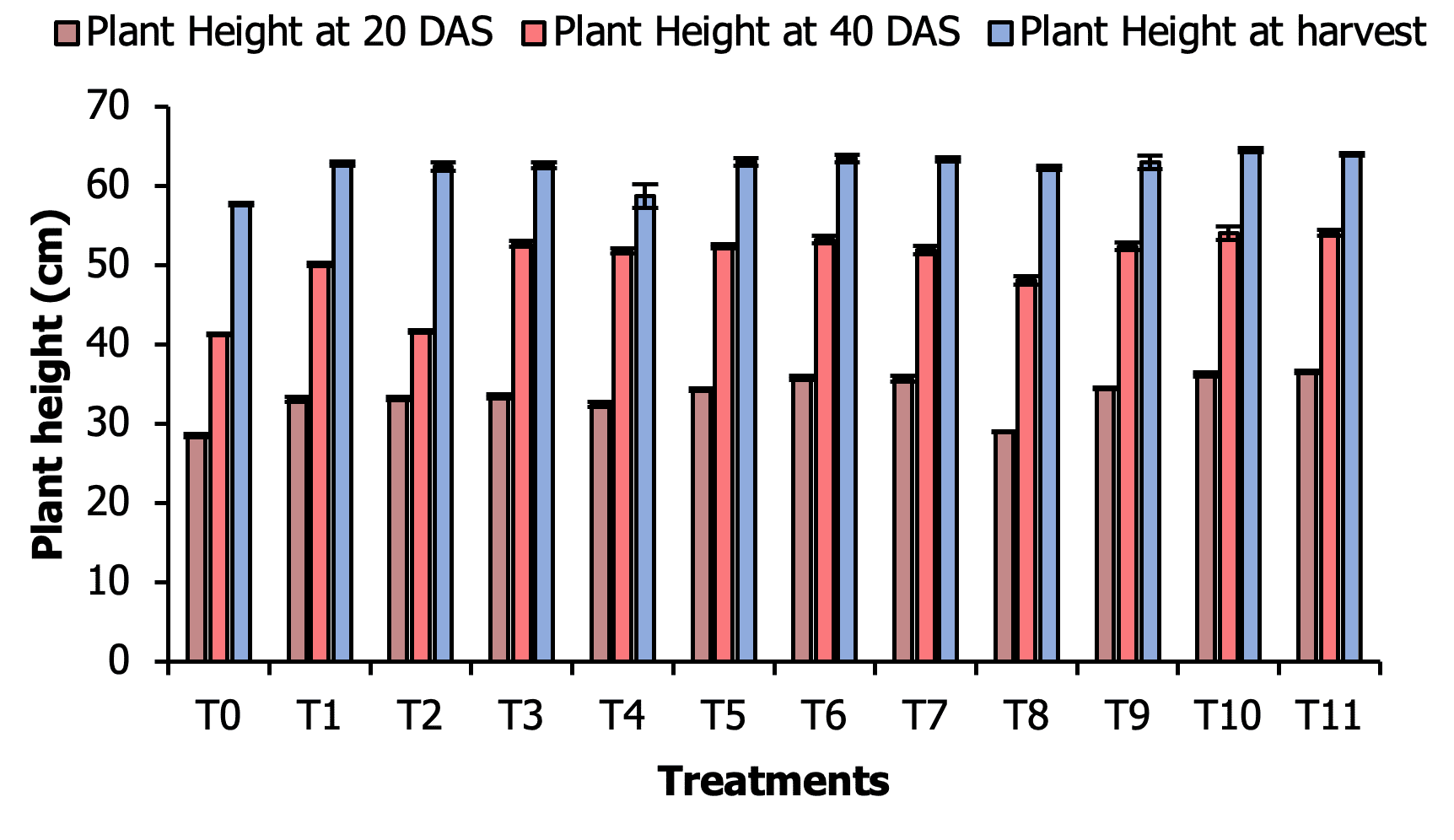
Different plant growth parameters were significantly influenced by the application of phosphorus and boron. Specifically, plant height increased by 28.22% at 20 DAS, 31.03% at 40 DAS, and 11.84% at harvest, compared to the control (Figure 2). The highest plant height was recorded in the T11treatment at both 20 and 40 DAS, while the T10 treatment exhibited the greatest height at harvest.
Leaf plant-1 exhibited a positive response to phosphorus and boron fertilization (Figure 3). The increase in leaf plant-1 was 87.19%, 24.56%, and 28.52% at 20 DAS, 40 DAS, and harvest, respectively, compared to the control. At 40 DAS, the highest total leaf number was observed in the T10treatment, while the maximum leaf number was recorded in the T11 treatment at both 20 DAS and harvest.

A significant improvement was observed in shoot and root dry weight due to phosphorus and boron application (Figure 4). The shoot and root dry weight augmented by 31.65% and 85.85%, respectively, in T11 treatment compared to the control.

As expected, the number of branches increased as the doses of phosphorus and boron fertilizer increased (Figure 5). The result revealed that number of branches plant-1 increased by 133.33% and 90% at 30 DAS and harvest, respectively, in T11 treatment compared to the control.

3.2 Yield and yield contributing parameters of green gram
The yield parameters improved pronouncedly with the application of phosphorus and boron likewise. As a result of different fertilizer levels, the number of flowers plant-1 showed a significant variation (Figure 5). The flower plant-1 was enhanced by 95.60% in T7 treatment compared to the control, which was statistically similar to T11 treatment. Following this total number of pods plant-1 also showed an increasing trend (Figure 6). The total number of pods plant-1 at 45 DAS and harvest increased by 135.14% and 35.95%, respectively, in T11 treatment compared to the control. Different levels of macro (P) and micro (B) nutrient application attributed to a significant difference in seeds pod-1 were noted (Figure 5). The highest number of seeds pod-1 was recorded in T11 treatment, which was statistically similar to T5, T6, T7, T9, and T10 treatments. However, the number of seeds pod-1 at harvest increased by 37.32% over the control.

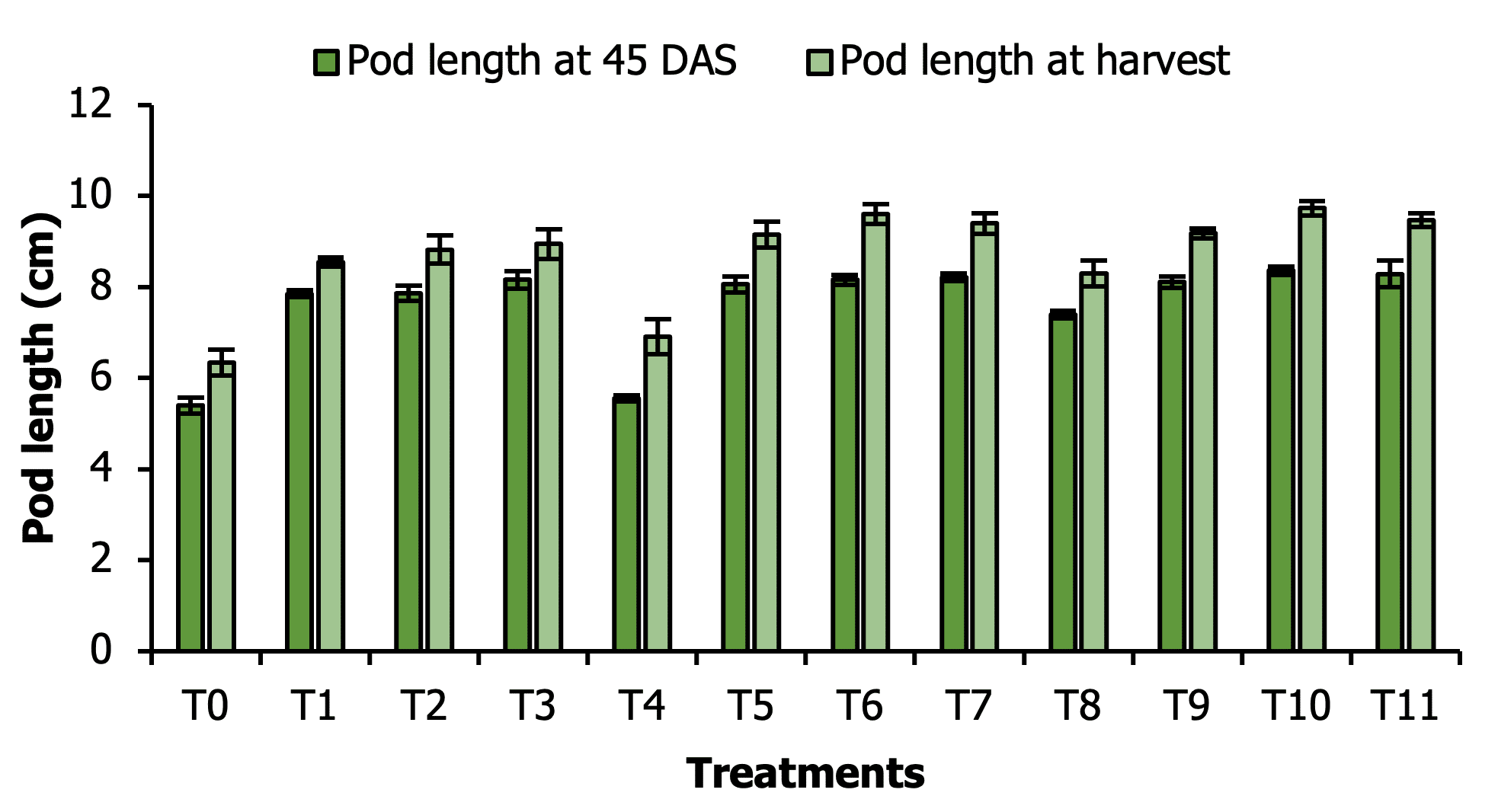
A further improvement was observed in pod length owing to combined application of macro (P) and micro (B) nutrients (Figure 7). At 45 DAS and harvest, the pod length increased by 54.81% and 53.47%, respectively, in T10 treatment compared to the control. The pod length observed in T10treatment was statistically identical to T11 treatment.
The yield parameters of green gram noted significant variations under different levels of P and B fertilization. At harvest, the thousand-seed weight increased by 20.69% in T10 treatment compared to the control (Figure 8).

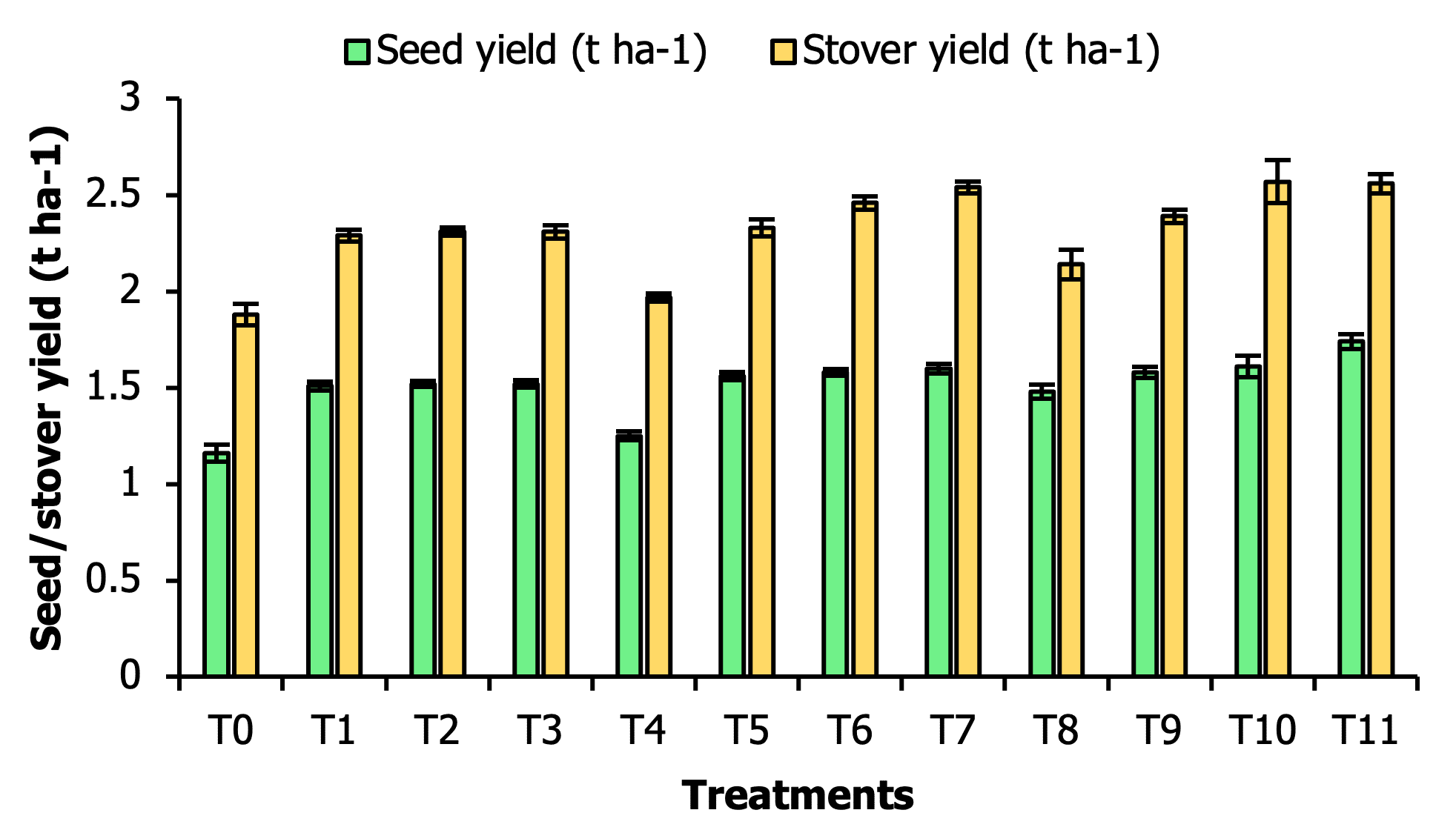
The stover yield increased by 36.70% in T10 treatment and the maximum seed yield was recorded in T11 treatment, which increased by 50% compared to the control (Figure 9).
4. Results and discussion
The application of macro and micronutrients is essential for enhancing the productivity of all field crops, including green gram (Mangaraj et al., 2023). This study aimed to determine the synergistic effects of phosphorus (P) and boron (B) fertilization on the growth and productivity of green gram (Vigna radiataL.). In tropical and subtropical regions, where nutrient deficiencies are common, green gram serves as a vital legume crop for sustainable agriculture. Our results indicate that integrated nutrient management (INM), particularly the combined application of phosphorus and boron, significantly improves the productivity of green gram.
Phosphorus and boron play essential roles in promoting vegetative growth and root development in green gram. The results indicate that the T11treatment (60 kg ha-1 P + 2 kg ha-1 B) resulted in the highest plant height, leaf count, and root and shoot dry weight, with increases of 28.22%, 31.03%, and 11.84%, respectively, at various growth stages. These findings are consistent with established research highlighting the importance of phosphorus in facilitating root and shoot growth in legumes (Khan et al., 2023; Bai et al., 2020). Phosphorus is a crucial nutrient involved in energy transfer, photosynthesis, root development, and overall plant vigor (Zhao et al., 2020). The observed improvements in plant height and leaf production in our study reinforce these mechanisms, underscoring phosphorus as a key contributor to the plant's photosynthetic capacity and biomass accumulation.
On a related note, boron is not required in high concentrations but is essential for maintaining cell wall integrity, membrane stability, and the proper functioning of reproductive processes in plants (Vera-Maldonado et al., 2024). Boron is particularly important for legumes, which often experience increased pollination and nitrogen fixation (Pereira et al., 2021). In this study, the application of boron resulted in significant enhancements in the number of branches and flowers per plant, highlighting its value in both vegetative development and reproductive success. This underscores the role of boron in ensuring the structural integrity of plant cells and its catalytic influence on growth.
The influence of phosphorus and boron on yield components was significant. Fertilization with phosphorus and boron led to marked increases in pod length, number of seeds per pod, 1000-seed weight, and stover yield, particularly with the T11 treatment. The T11 treatment resulted in a 135% increase in the number of pods per plant at 45 DAS and a 35% increase at harvest compared to the control. This finding aligns with other research highlighting the beneficial effects of phosphorus and boron on legume reproduction (Khan et al., 2023; Nejad and Etesami, 2020).
The observed 50% increase in seed yield under the T11 treatment represents a significant achievement, highlighting the importance of INM in enhancing legume productivity. The synergistic effect of phosphorus and boron is particularly noteworthy, as these nutrients interact to maximize their benefits. Phosphorus promotes the development of the root system, which enhances nutrient uptake, including boron. In turn, boron stabilizes metabolic pathways crucial for flower and pod development (Pang et al., 2024; Zhao et al., 2020). This interaction is reflected in the improved seed yield and overall productivity observed in our study. Additionally, the increase in stover yield underscores the broader ecological benefits of these nutrients. The additional biomass not only contributes to higher yields but also plays a vital role in sustaining soil health. By recycling organic matter back into the soil, increased stover enhances soil fertility and supports long-term agricultural sustainability.
The findings of this study have significant implications for sustainable agriculture, particularly in regions where phosphorus and boron deficiencies hinder crop productivity. Soil erosion, inadequate nutrient management, and excessive use of chemical fertilizers contribute to the scarcity of these nutrients in tropical and subtropical areas, such as Bangladesh (Baijukya et al., 2021). Our results indicate that balanced applications of phosphorus and boron can help address these deficiencies, improve crop production, and sustain agricultural practices. This study also emphasizes the importance of site-specific fertilizer recommendations for phosphorus and boron. In nutrient-deficient areas, farmers should adopt integrated nutrient management strategies to prevent over-fertilization, which can lead to nutrient imbalances and negatively impact the environment (Selim, 2020). Further research is needed to identify optimal fertilization levels for various soils and climates to maximize output while minimizing environmental impact.
5. Conclusions
The present study demonstrated that phosphorus and boron play a vital role in enhancing the growth and yield performance of green gram. The interactive effects of these nutrients functioned synergistically, as their combined use significantly influenced plant height, branch number per plant, leaf number per plant, and the accumulation of dry matter in both the roots and shoots. Phosphorus and boron fertilization also had a substantial impact on all yield characteristics of green gram. Among the treatments, T11 experienced the greatest seed yield, showing a fifty percent increase relative to the control, along with impressive gains in thousand seed weight and stover. These results suggest that the combination of boron and phosphorus can ensure a greater nutrient supply and uptake, leading to increased productivity of green gram in nutrient-deficient soils. Therefore, it is recommended to balance phosphorus and boron application to manage nutrients effectively, thereby boosting yields and enhancing soil fertility as part of a sustainable production system for legumes. The research also identifies gaps, particularly regarding the long-term impacts of phosphorus and boron on soil health and their cycling. Future studies should focus on managing these nutrients across different soils and climatic conditions, maximizing fertilization rates, and examining the overall ecological effects to establish stable and appropriate practices within diverse agricultural systems.
Acknowledgements
The authors express their sincere gratitude to Sher-e-Bangla Agricultural University, Bangladesh, for their support.
Source of funding
The research didn’t receive funding from any organization.
Data availability
The data generated from this study might be shared with a valid request from the corresponding author.
Informed consent statement
No informed consent was required to conduct the study.
Conflict of interest
The authors declare no conflict of interest.
Authors’ contribution
Conceptualization: Mohammad Mahmudul Hasan, Md. Sajjad Hossain, Rafiqul Islam; Data collection: Mohammad Mahmudul Hasan, Md. Sajjad Hossain, Md. Sowban Chowdhury, Abul Hasan Razu; Data analysis: Mohammad Mahmudul Hasan, Md. Sajjad Hossain; Figure preparation: Mohammad Mahmudul Hasan, Md. Sajjad Hossain, Md. Sowban Chowdhury. All the authors equally contribute to do research and manuscript preparation.
